
What is Order Management? A Guide for Specialty Manufacturers & Distributors
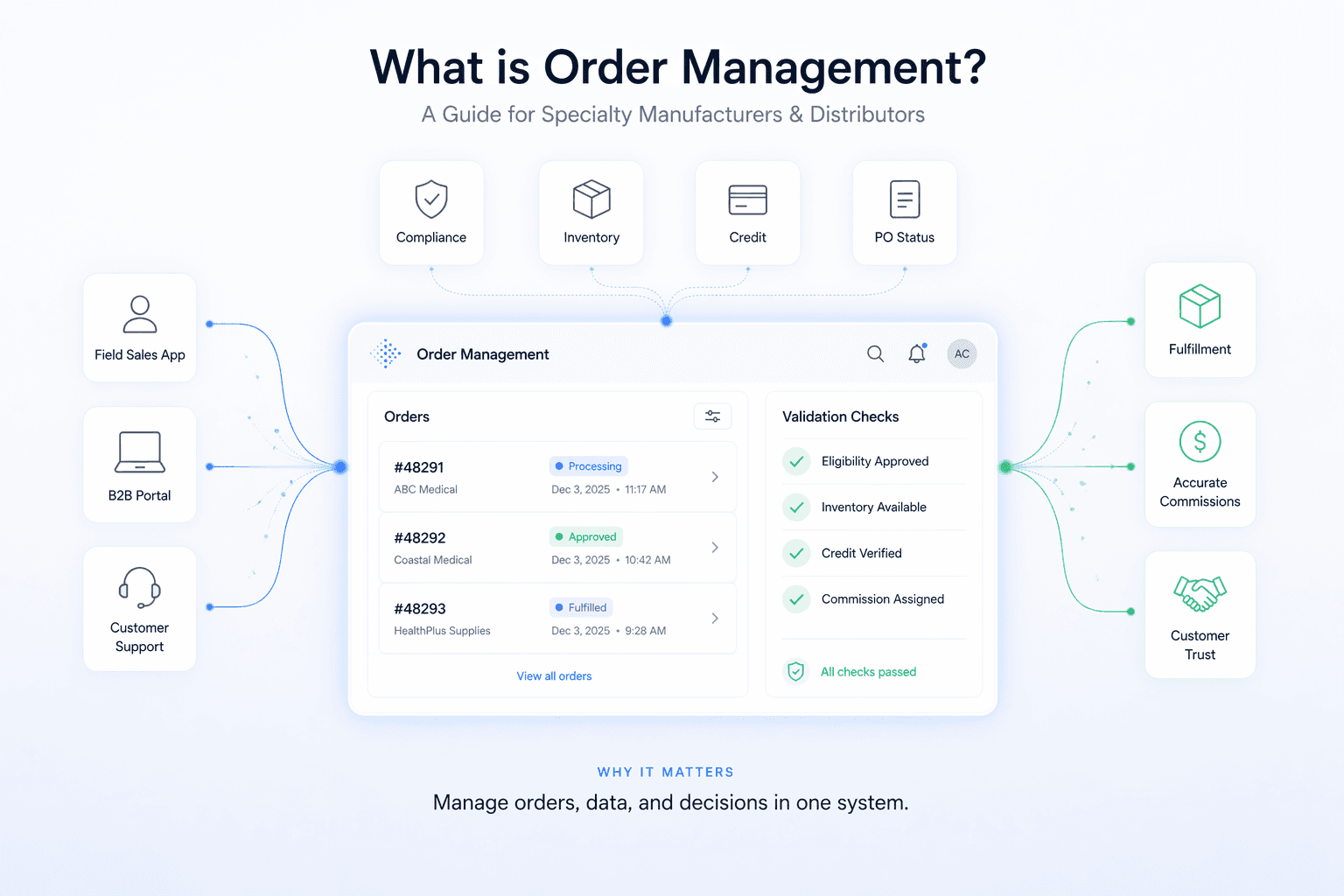
What Is Order Management?
Order management involves tracking orders from inception to fulfillment, as well as managing the people, processes, and data associated with each order.
For manufacturers and distributors, this isn't just about shipping a box. It answers critical questions:
Eligibility: Is this account authorized to buy this product?
Inventory: Do we have stock in the warehouse, or does the sales rep have it in their trunk (consignment)?
Credit: Who gets the commission for this sale?
Status: Has the PO been approved and shipped?
When order management is done well, you get fewer compliance issues, accurate commission payouts, and higher trust from your practices and providers.
The Order Management Process
While retail creates simple flows, the B2B flow is more robust:
Order Capture: A Field Rep places a quote via mobile, or a client orders via a portal.
Validation: The system checks pricing tiers, contract terms, and account status.
Inventory Allocation: Stock is reserved (from a warehouse or trunk stock).
Fulfillment Plan: Logic decides if the order ships in one go or splits based on availability.
Ship & Deliver: The product moves, and the status is updated for the rep and customer.
Post-Purchase: Invoicing, revenue recognition, and handling potential returns.
Problems usually show up when these steps are disconnected. For example, when a Rep sells inventory that the warehouse doesn't actually have.
What is an Order Management System (OMS)?
An Order Management System (OMS) is software that helps manage the order lifecycle in one place. It gives your sales, operations, and finance teams a "single source of truth."
A specialized B2B OMS supports:
Complex Pricing: Managing different price lists for different hospital groups (GPOs) or territories.
Inventory Visibility: Seeing stock across central warehouses and field rep inventory.
Fulfillment Routing: Automated shipping rules.
Integrations: Connecting your CRM to your ERP.
B2B Omnichannel: Reps, Portals, and Support
In retail, "Omnichannel" means buying online and picking up in-store. In high-growth B2B markets, Omnichannel means seamless data across your business units.
Common scenarios include:
A Sales Rep creates a quote on an iPad or mobile device.
The Sales Rep logs into a B2B portal later to approve and pay for it.
Customer Service sees the transaction history if the customer calls with a question.
The key requirement is synchronization: If a Rep sells a device or product in the field, your B2B portal needs to know that inventory is gone immediately.
Distributed Order Management (DOM) & Consignment
Distributed Order Management (DOM) is the logic that decides where an order should be fulfilled from.
In specialty markets, inventory lives in many places:
Central Distribution Centers
Regional Hubs
Consignment / Trunk Stock (Inventory held by sales reps or at client locations)
A strong DOM system balances delivery speed and shipping costs while ensuring you rotate stock effectively to avoid expiration.
Order Management in Order-to-Cash (O2C)
Order-to-Cash (O2C) is the financial process from order creation to getting paid. Order management supports O2C by ensuring the order data is clean before it hits the finance team.
Accurate order data leads to:
Faster invoicing.
Fewer disputes over pricing or discounts.
Quicker commission payouts to sales teams.
B2B vs. B2C Order Management
Why can’t manufacturers just use a standard retail plugin? Because B2B is fundamentally different.
Feature | B2C / Retail | B2B / Specialty (Velocity) |
|---|---|---|
Buyer | Single Shopper | Procurement Teams / Practices |
Pricing | One Price for All | Contract / Tiered Pricing |
Volume | Low Quantity, High Volume | Bulk Orders, Pallet Shipping |
Approval | Immediate Payment | PO Approvals & Net Terms |
Inventory | Warehouse Only | Warehouse + Field Consignment |
How to Know Your Order Management is Working
A short KPI set to track health:
Perfect Order Rate: (On time, complete, undamaged, correct documentation).
Order Cycle Time: Speed from "PO Received" to "Product Shipped."
Backorder Rate: How often you sell stock you don't have.
Sales Rep Adoption: Are reps using the app, or calling in orders manually?
Commission Accuracy: How often are payouts disputed?
Final Thoughts
Order management is the engine of a product-based business. It connects your field sales team to your warehouse and your finance department.
If you are looking for a platform built specifically to handle the complexity of specialty manufacturing, from field sales apps to complex compliance, Velocity is designed to streamline these workflows where generic software falls short.