
B2B Order Management: 5 Challenges Scaling Businesses Face (And How to Fix Them)
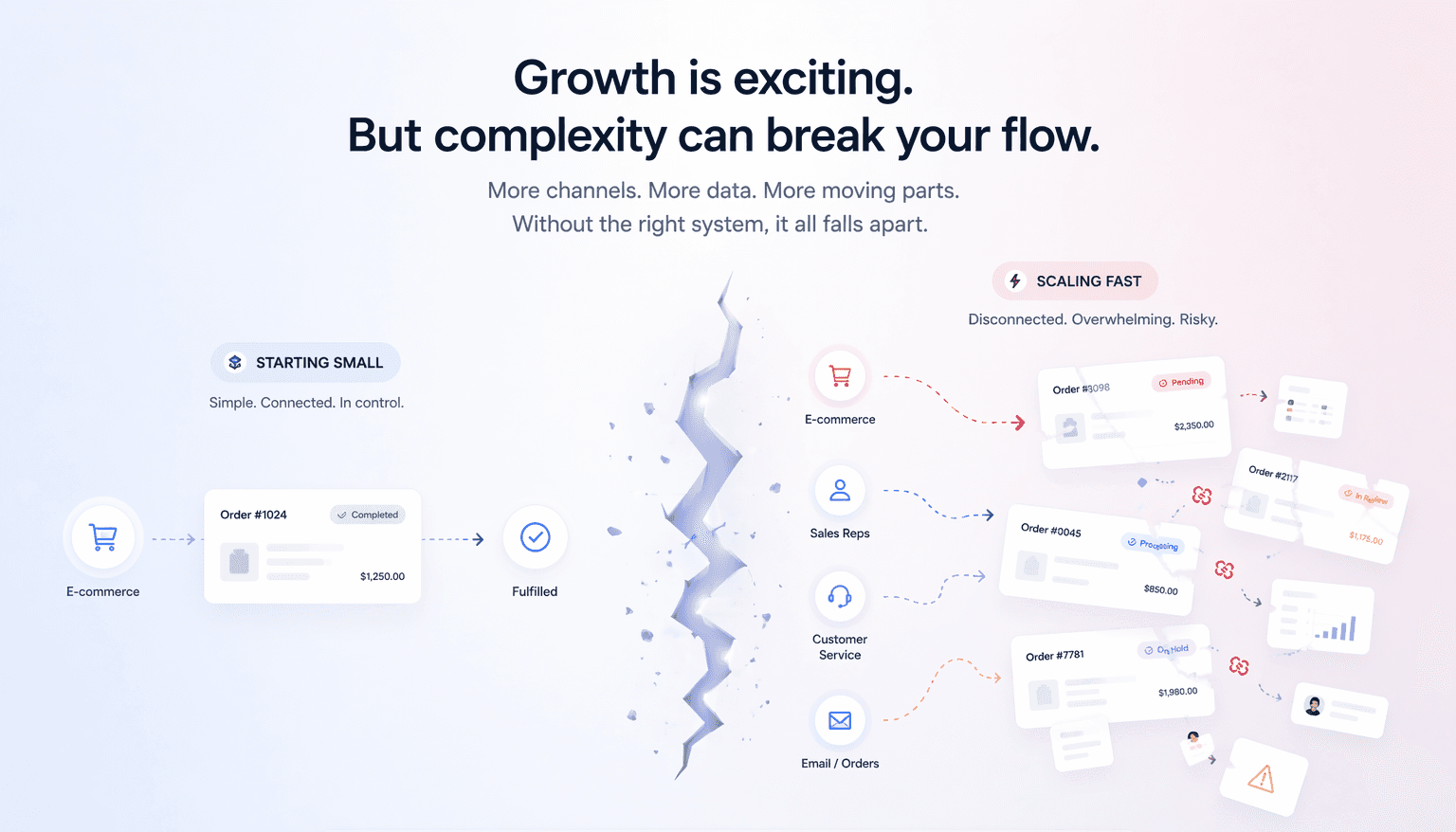
Growth is the goal for most B2B businesses, but with growth comes friction. As order volume increases, sales channels multiply, and teams expand, processes that once felt manageable begin to strain. What worked for a small sales team taking orders by email or phone quickly breaks down when the business starts scaling. The result is often operational drag, limited visibility, and frustrated sales teams.
Friction doesn’t mean that you’ve failed, but it is to be expected, and the difference between companies that stall and companies that scale successfully is whether they put the right systems in place at the right time.
And companies that scale also recognize that their problems are not unique; they don’t look to reinvent the wheel every time there’s a bump in the road. From B2B order management and sales enablement to automated commission calculations and territory mapping, every problem your business faces has been faced before and will be faced again. Being prepared for these issues gives you the opportunity to turn mountains into molehills and scale with ease.
Problem 1: Orders Coming From Everywhere, With No Single Source of Truth
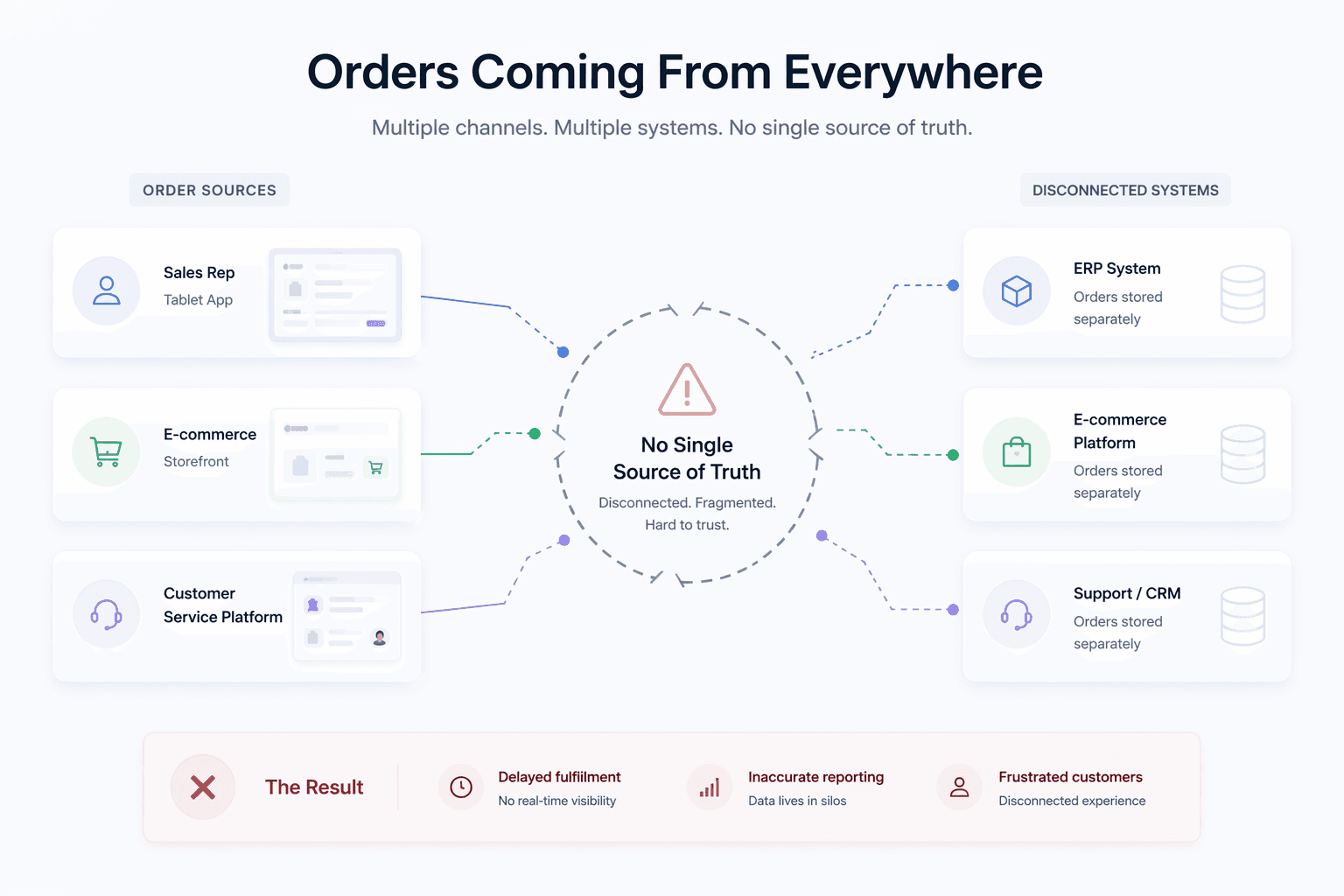
As B2B companies scale, orders stop coming from just one place. Some customers order through e-commerce. Others prefer working directly with their sales rep to help them get onboarded and place orders. Internal teams may still enter orders manually for key accounts or wholesale partners.
This creates a fragmented B2B ordering environment. Sales rep orders, e-commerce orders, and customer service orders are all being completed through different systems, leading to manual work for internal operational teams.
Without a unified approach to B2B order management, teams struggle to answer basic questions. Which orders are complete? Which rep gets linked? What's the commission calculation? The lack of a single source of truth introduces delays, errors, and frustration across the organization.
Problem 2: Disconnected Systems That Don’t Talk to Each Other
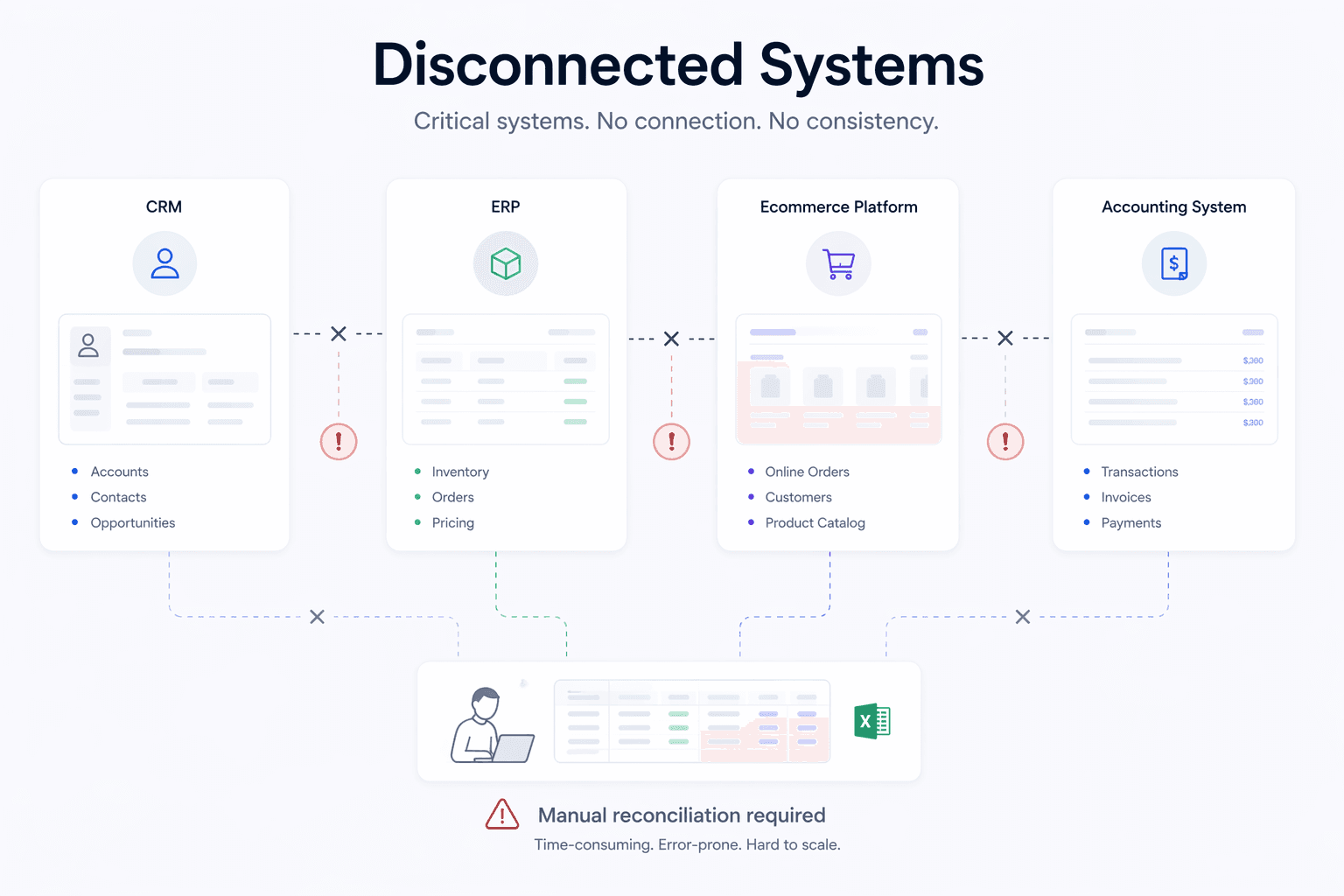
Silos belong on farms – not in your tech stack. But many B2B businesses rely on a growing stack of disconnected tools to support sales and operations. E-commerce platforms manage storefronts. ERPs handle inventory and fulfillment. CRMs track customer relationships. Accounting systems manage billing. Individually, these systems work. Together, they often do not.
And that creates a cascade reaction. When sales teams lack visibility into fulfillment or inventory status, it requires that operations teams manually reconcile orders across platforms. And the reports that leadership needs to make decisions can take weeks to complete. These silos make it nearly impossible to get a real-time view of performance across Shopify sales, BigCommerce B2B wholesale accounts, and direct sales channels. And as your order volume grows, the cost of disconnected systems grows with it.
Problem 3: Inefficient, Manual Sales Order Management Processes
Early-stage B2B businesses often rely on manual processes longer than they should, usually out of a sense of caution and the desire to build trust. Orders are re-entered to ensure that they’re right, and pricing is double-checked by hand. Approvals and exceptions are handled over email or the phone, and everything is managed individually.
As B2B wholesale ordering scales, these processes become bottlenecks. Manual workflows slow fulfillment, increase error rates, and limit how fast a business can grow. This is especially painful for teams supporting rep-assisted and wholesale ordering, where speed and accuracy directly affect customer trust and sales momentum.
Problem 4: Sales Teams Lacking Autonomy and Visibility
Sales reps are often closest to customers, yet many B2B organizations limit what reps can do because their order management systems were not built for sales-driven ordering. Regardless of which e-commerce platform sales reps are placing orders in, the lack of a true B2B sales rep portal creates friction that impacts both internal teams and customer experience.
Reps rely on back-office teams to place orders, check order status, or confirm commission eligibility. This slows the sales cycle and creates unnecessary handoffs. It also reduces accountability, since orders are not clearly tied to individual reps or territories.
Problem 5: Lack of Consolidated Reporting and Operational Visibility
As businesses mature, leadership needs more than top-line revenue numbers. They need insight into performance by channel, rep, territory, and customer type. They need to understand how e-commerce, wholesale, and direct sales channels interact.
Without consolidated reporting, this visibility is impossible to achieve. Data lives in multiple systems, reports are manually compiled, and insights arrive too late to be actionable. If you’re dealing with a complex B2B order management system spread across platforms, the absence of unified reporting makes strategic planning reactive instead of proactive.
Unification Is The Solution
Ultimately, there will come a point where patching solutions together simply doesn’t work. Your business won’t fall apart overnight, but growth (and every process along the way) will slow. Fragmentation isn’t a symptom of the problem; it is the underlying problem, and point solutions will only go so far.
Growing B2B organizations need infrastructure that connects the sales process from end to end. That means linking channels, systems, teams, and data in a way that supports the business as it exists today while also preparing it for where it is going next. A unified B2B order management solution is the only way to create organizational consistency.
And consistency is important, because when you look at them in practice, sales and operations are not separate functions. They are deeply connected. A rep cannot sell effectively without visibility into inventory, pricing, and order status. Operations cannot execute efficiently if orders are incomplete, inconsistent, or scattered across systems. Finance cannot report accurately if order attribution and billing data are unreliable. Leadership cannot plan strategically if every answer requires pulling numbers from multiple sources and reconciling them manually.
A unified B2B solution helps solve these issues by creating a shared operational framework. It gives teams one place to manage and track orders, one logic layer for how orders move through the business, and one view of the data needed to make decisions. It also reduces the reliance on tribal knowledge, manual intervention, and workarounds that tend to accumulate as businesses grow.
Unification is scalability. With the right foundation in place, businesses can add channels, onboard more reps, support more customers, and handle more complexity without multiplying administrative burden at the same rate.
How To Choose A Unified B2B Order Management System
Now that you see the need for unification, you have to pick a solution – and that’s where things get complicated, because not every platform that claims to simplify B2B operations is built to handle the realities of modern sales environments. When evaluating options, businesses should look beyond surface-level feature lists and focus on whether a solution can genuinely connect the systems and workflows that matter most.
Integration flexibility should be one of the first considerations. A strong solution should work with the systems you already rely on, including e-commerce platforms, ERP software, CRM systems, and all of your enterprise’s accounting tools. Replacing every part of the tech stack is expensive and disruptive, so the best platforms tend to complement existing infrastructure rather than force a complete rebuild. This supports the part of your organization that needs stability.
Multi-channel sales order management is equally important because that’s what allows growth. Businesses need the ability to manage e-commerce, rep-assisted, wholesale, and customer service orders within a unified environment. If a platform only handles one ordering path well, it may solve a narrow issue without addressing the broader operational picture.
Those are the top two priorities, but they aren’t the only features your unified solution needs.
Sales rep enablement should also be a concern. Reps need tools that let them place orders, access account details, track order status, and operate with greater independence. A system that improves internal control but leaves reps dependent on the back office only shifts the bottleneck, instead of eliminating it.
Order attribution and commission support matter too. As businesses scale, it becomes increasingly important to know which rep, territory, or account owner should be associated with each transaction. Clear attribution supports cleaner reporting, more accurate compensation, and better performance management.
Finally, reporting and visibility should be built into the platform, not treated as an afterthought. Leadership needs real-time access to dashboards and consolidated insights across sales channels and operational workflows. If reporting still depends on manual exports and spreadsheet cleanup, the system is not truly solving the visibility problem.
Velocity Commerce: Your Unified B2B Order Management Solution
Finding the right solution takes time, but front-loading that effort means avoiding the growing pains that can stop a company in its tracks. The right unified B2B solution is intentionally designed to address the complexity of modern B2B sales and operations.
Velocity Commerce is that tool. It acts as a centralized layer that brings together B2B order management, sales team ordering portals, e-commerce platforms, and backend systems without requiring businesses to replace what already works. Regardless of which commerce platform is in place, or whether a traditional storefront exists at all, Velocity supports multi-channel sales workflows in one unified environment. It also gives your sales reps autonomy through a true B2B sales rep portal, and that gives leadership real-time visibility through consolidated reporting and dashboards.
Growth is good. But it can be overwhelming – the trick is not letting growth turn into overgrowth. Come see how the right technology prunes the thorns and soothes your B2B growing pains. Learn more about how Velocity Commerce brings everything together when you schedule a demo today.