
6 Make-or-Break Criteria for Choosing a B2B Ecommerce Platform
Remember when your company was just starting to bloom? Everything seemed so simple and exciting. Your orders came in through one channel, and your small sales team tracked customers in a shared spreadsheet. That was it! Commissions were easy to calculate at the end of the month; only a little cleanup was needed, and reporting required just a dashboard or two. All you needed was a lightweight toolset.
But then growth happened, and while the increased scale and income were wonderful, chaos started to creep in at the corners as you served your customers, and leadership had questions that just could not be answered from a single source of truth. Disorder is a natural part of growth. It happens – just as seeds grow into forests, your startup grew up to be an enterprise. Once your company knew it would survive, the question was how to help it thrive.
Disorder is a natural part of scaling, but it does not have to become a permanent condition. The right unified B2B ecommerce platform helps growing organizations move from patchwork processes to a connected operating model that can support what comes next.
What To Look For in a B2B Ecommerce Platform
Growing pains are one of the biggest challenges for any B2B organization, especially when it comes to solutions. When the company’s needs outpace the early toolset, it can feel risky and disruptive to replace those tools – particularly if the organization is scrambling for point solutions.
But that’s why unified B2B ecommerce platforms matter. The best ones do not force rigidity. They create a framework that reflects how the business actually operates, then make that framework easier to manage as scale increases.
In practice, that means a business can support ecommerce orders, rep-assisted orders, and customer service orders within one omnichannel system. It can assign ownership consistently, calculate commissions automatically, and move data through the organization in a way that supports reporting and decision-making. Instead of relying on siloed knowledge and after-the-fact cleanup, the company gains a more reliable process from the start. Growth still brings complexity, but it does not have to bring chaos with it.
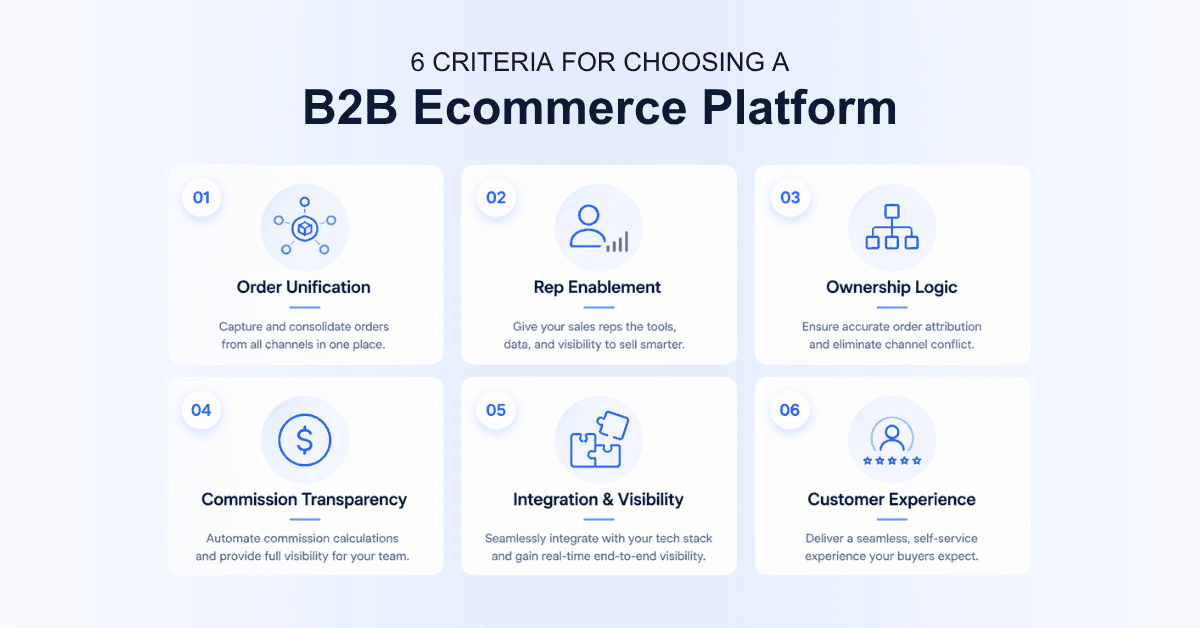
What your company needs is a system that can unify how orders, people, and data move through the business. There are many systems out there, and each one promises to have what you need. But what do you really need? It can be hard to make a decision, but the best way to do it isn’t to look for individual features. Instead, look at how the solution addresses these six major pain points.
The first consideration is order unification. As businesses grow, orders start coming from everywhere: ecommerce storefronts, sales reps, customer service teams, and strategic account workflows. If those orders are managed in disconnected ways, visibility breaks down quickly. A strong platform should bring those order sources into one coherent system so the business has a reliable view of what is happening across every sales path. For a deeper look at how B2B order management challenges compound as you scale, see our breakdown of the five most common friction points.
The second consideration is rep enablement. Many B2B organizations expect reps to drive revenue while still requiring them to depend on store admins or back-office teams for routine actions. That slows down the sales process and creates bottlenecks. A strong platform gives reps visibility and speed through a dedicated B2B sales rep portal, while leaving the business with control and clean governance.
The third consideration is ownership logic. As sales teams expand, assigning the right rep or team to the right account becomes more important and more complicated. Some organizations use strict territories. Others work from named accounts. Many use a hybrid model with layered ownership. A strong solution should support the structure the business actually uses rather than forcing the sales organization into an artificial model. Territory mapping, shared ownership, and automatic order linkage become part of the operational backbone as scale increases.
The fourth consideration is commission transparency. Manual commission processes create distrust quickly. If reps cannot see how attribution works, or if finance has to reconstruct payouts from spreadsheets and exports, the result is wasted time and unnecessary friction. A strong platform should connect orders, ownership, and commission calculations in one clear process. That creates more confidence for reps and less administrative strain for finance and operations.
The fifth consideration is integration and visibility. A unified B2B ecommerce platform should not become another silo. It should work with the systems the business already relies on, including ERPs, CRMs, and financial platforms, while making data more useful across the organization. Reporting and executive dashboards matter because mature organizations do not just need to execute orders. They need to forecast, measure accountability, and answer strategic questions without waiting on multiple exports and manual explanations.
The final consideration is customer experience. It might seem unintuitive to put customer experience last, but without a strong internal structure, you can’t support a healthy buying experience. A useful solution should make it easier to shape the storefront experience based on customer type, rep relationship, or account group, so buyers see what is most relevant to them. That means less friction at the point of purchase and a more tailored experience that supports loyalty over time.
How Velocity Commerce Delivers on B2B Ecommerce Best Practices
For mature organizations, visibility is just as important as execution. Velocity Commerce supports shipping and fulfillment workflows while integrating with the systems leaders already rely on, including financial platforms, ERPs, and CRMs. And with Velocity, data does not live in silos. It flows through the organization in a way that supports forecasting, accountability, and decision-making.
Reporting and executive dashboards instantly bring that data together. Questions that once required multiple exports and explanations can be answered quickly and confidently with Velocity as the data aggregator that keeps you from wandering off the path.
Velocity also considers that what your customer sees is just as important as what you see. Their experience matters, and thanks to Velocity’s customer handling, it can be customized from a sales rep’s mobile phone. For example, Velocity lets you tag your customers by group and can change what they see on your ecommerce storefront. This means that an aesthetician doesn’t have to waste time sorting through pages of cardiac surgery supplies and can place their order without any friction, which improves loyalty.
The plumbing — all the systems and operations behind the scenes — is critical to maximizing overall performance. For Obagi, Velocity gives a contemporary foundation, enabling us to operate smarter and position ourselves for long-term success. With that in place, we can truly differentiate through our product, our brand, and our customer focus.
– US General Manager, Professional Channel - Obagi Medical
Planting the Seeds for an Easier Tomorrow
The common thread through every stage is continuity. Velocity grows with the business, supporting startups as they scale and scaling alongside them as they mature. It replaces patchwork processes with a unified platform that reflects the reality of modern B2B selling. Growth does not have to mean losing control. With Velocity, it becomes an opportunity to build smarter, more connected operations that are ready for whatever comes next.
Ready to see how Velocity Commerce will support your B2B ecommerce strategy? Contact us today to set up a demo.