
B2B Order Fulfillment: How It Works and Why Reporting Makes or Breaks It

A wholesale customer places a $40,000 order on net 60 terms. Half ships from one warehouse, the rest goes on backorder, and the retailer expects an exact delivery window and compliant labeling on every pallet. That is one order.
B2B order fulfillment is the process of ensuring hundreds of orders like this are picked, packed, shipped, and invoiced accurately. It looks very different from sending a single parcel to a consumer’s doorstep.
TL;DR: B2B order fulfillment is the end-to-end process of receiving, processing, and delivering orders from one business to another. Compared with B2C, it involves larger orders, freight shipping, negotiated pricing, net payment terms, and stricter compliance requirements. The fulfillment steps themselves (placement, processing, picking, shipping, invoicing) are only as reliable as the order data behind them, which is why companies that unify rep, ecommerce, and customer service orders in a single order management platform see fewer fulfillment errors and far cleaner reporting on shipments, backorders, and delivery performance. |
|---|
INDEX
What Is B2B Order Fulfillment?
How the B2B Order Fulfillment Process Works
B2B vs B2C Fulfillment: The Differences That Matter
Common B2B Fulfillment Challenges
Where Order Management Ends and Fulfillment Begins
How to Evaluate Fulfillment Partners and Software
FAQs
What is B2B order fulfillment?
Is UPS a B2B company?
What are B2B orders?
What is the difference between B2B and B2C fulfillment?
What Is B2B Order Fulfillment?
B2B order fulfillment is the end-to-end process of receiving, processing, picking, packing, shipping, and invoicing orders placed by one business to another. It includes everything that happens between a wholesale buyer submitting a purchase order and receiving the goods, supporting documentation, and an accurate invoice that matches both.
In practice, the buyers are retailers, distributors, dealers, and other companies purchasing for resale or for their own operations. Their orders tend to be large, recurring, and governed by negotiated agreements, including customer-specific pricing, net payment terms, routing guides, and labeling requirements rarely found in consumer transactions.
So while B2B and B2C fulfillment share the same basic mechanics, the B2B version carries far more contractual weight. A late or incorrect shipment to a consumer costs you one refund. A late or incorrect shipment to a retail customer can trigger chargebacks, damage a business relationship, and put recurring revenue at risk.
How the B2B Order Fulfillment Process Works
Most B2B fulfillment operations follow the same six stages, whether fulfillment is handled in-house or outsourced to a third-party logistics (3PL) provider. What separates a clean operation from a chaotic one is rarely the stages themselves. It comes down to how reliably order data moves between them.
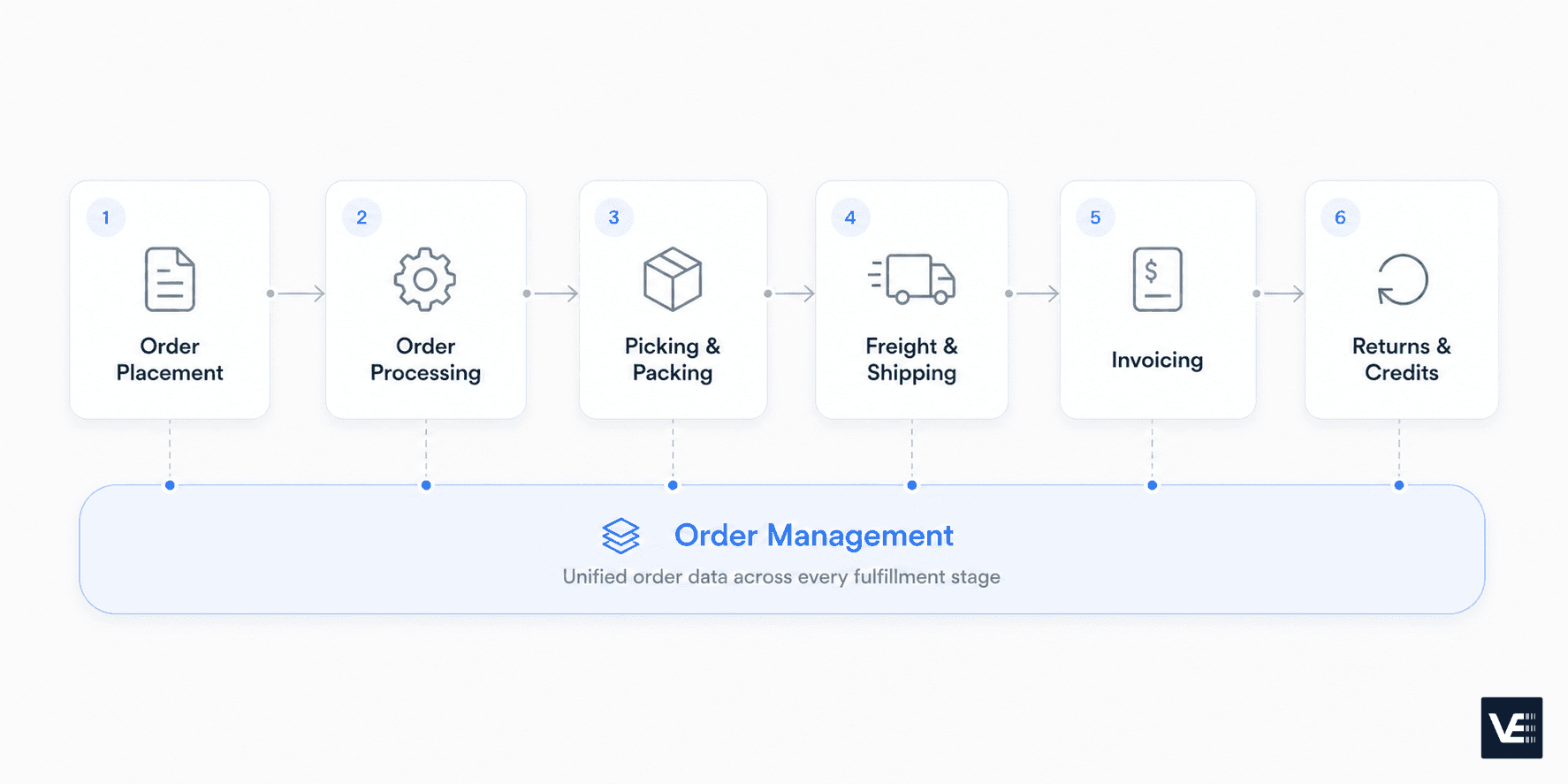
1. Order Placement
B2B orders arrive through more channels than most teams realize: field sales reps, ecommerce storefronts, customer service, EDI connections with larger retailers, and, in many companies, email and spreadsheets. Each intake channel is a place where pricing, quantities, and customer terms can be captured correctly or incorrectly, and every downstream stage inherits that result.
2. Order Processing and Validation
Once an order is in, it has to be validated before anything moves in the warehouse: confirming the customer's negotiated pricing, checking credit limits and payment terms, verifying inventory availability across locations, and flagging anything that needs approval. Skip or rush this stage, and those errors typically surface later as invoice disputes, fulfillment issues, and costly rework.
3. Picking and Packing
Warehouse teams pick the ordered items and pack them according to the customer's specifications. In B2B, those specifications are often contractual: case packs, palletization rules, carton labeling, and packing slips formatted the way the receiving warehouse requires. Big-box retailers in particular enforce these rules through routing guides, and they fine suppliers who get them wrong.
4. Freight and Shipping
Bulk orders typically ship as LTL (less than truckload) or FTL (full truckload) freight rather than small parcels, with delivery appointments scheduled in advance. Smaller B2B orders may still go through parcel carriers. Regardless of the shipping method, buyers expect accurate tracking, shipment notifications, and documentation such as bills of lading.
5. Invoicing and Payment
B2B transactions rarely settle at checkout. Invoices reflect negotiated pricing and net terms (net 30, 60, or 90), so accounts receivable depend on the invoice matching the purchase order and the shipment exactly. Three-way matching falls apart quickly when order, shipment, and invoice data are spread across multiple systems.
6. Returns, Credits, and Adjustments
Wholesale returns involve restocking fees, credit memos, and replacement logic that must trace back to the original order and, in rep-driven businesses, to the commission paid on it. A return that never reconciles against its source order quietly distorts revenue, inventory, and commission reporting at the same time.
B2B vs B2C Fulfillment: The Differences That Matter
The clearest way to understand B2B fulfillment is to compare it with the consumer fulfillment most people already know. Both follow the same basic fulfillment process, but the requirements surrounding that process are substantially different.
Dimension | B2B Fulfillment | B2C Fulfillment |
|---|---|---|
Order Size | Bulk orders, pallets, high order value | Single items or small baskets |
Pricing | Negotiated, customer-specific, tiered | Uniform list pricing |
Payment | Net terms, credit limits, invoicing | Paid at checkout |
Shipping | LTL/FTL freight, delivery appointments | Parcel carriers, fast delivery |
Compliance | Routing guides, EDI, labeling standards, chargebacks | Minimal |
Relationship | Recurring, contractual, rep-managed | Transactional |
Error cost | Chargebacks, strained contracts, lost recurring revenue | Single refund or reshipment |
But the most consequential difference is not on this table. B2C fulfillment serves anonymous buyers at list price. B2B fulfillment serves named customers with negotiated terms, which means the fulfillment operation has to know who the customer is, what they agreed to pay, and what was promised, on every single order. That knowledge lives in your order data, not in your warehouse.
Common B2B Fulfillment Challenges
Most fulfillment failures in B2B trace back to a handful of recurring problems, and the majority of them start before the warehouse ever sees the order.
Fragmented Order Intake
The most common failure is the same customer existing in three systems with three different prices. When rep orders arrive by email, ecommerce orders sit in a storefront database, and customer service keys orders into an ERP, every disconnected intake channel becomes another version of the truth. Velocity Commerce's breakdown of the operational chaos created by scattered systems shows how fulfillment, finance, and sales each end up reading a different story.
Pricing and Terms Errors
Pricing mistakes follow directly from that fragmentation. If the order management system doesn’t contain a customer’s current negotiated pricing, someone must look it up manually – and manual lookups become increasingly unreliable as order volume grows. The result is invoice disputes that delay payment and erode trust with exactly the customers who order the most.
Backorders and Split Shipments
Partial fulfillment is normal in wholesale; losing track of it is not. When open balances are tracked in spreadsheets instead of against the original order, backorders become difficult to manage, customers chase status updates, and finance loses visibility into booked versus shipped revenue.
Compliance Pressure
EDI requirements, retailer routing guides, and labeling standards often penalize inconsistencies through chargebacks. These are the scaling challenges that growing B2B operations hit hardest, because manual processes that worked at 50 orders a month break visibly at 500.
Where Order Management Ends and Fulfillment Begins
Fulfillment can only be as accurate as the sales order that feeds it, which is why the highest-impact fulfillment improvements usually happen in order management. A warehouse can pick flawlessly and still ship the wrong thing if the order carried the wrong price, the wrong quantity, or an outdated ship-to address. The 3PLs that dominate this conversation write about the warehouse. The step before the warehouse deserves equal attention.
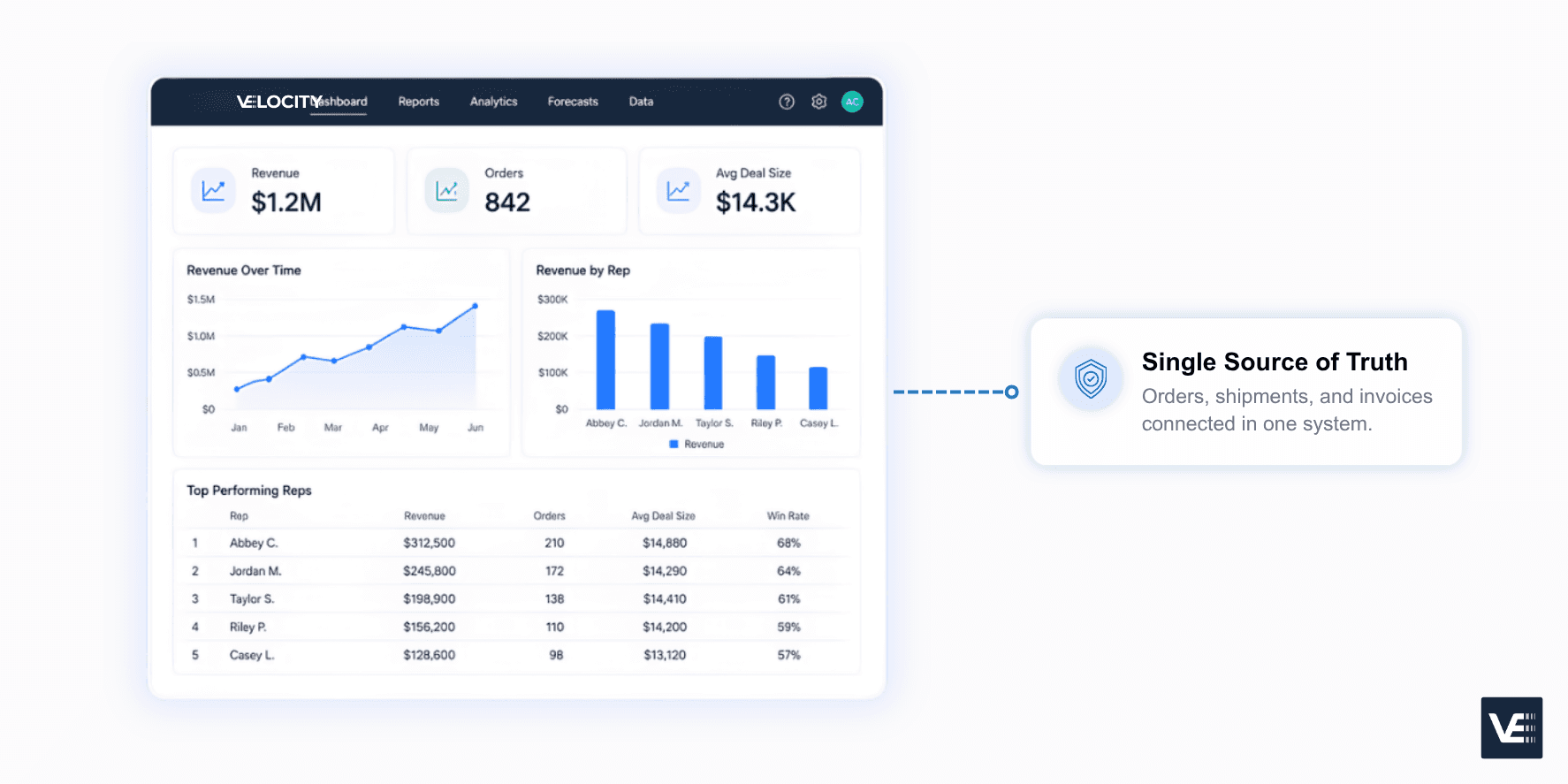
This is the problem a centralized order management platform is designed to solve. When orders from field reps, ecommerce, and customer service all enter one system, fulfillment receives a single, validated stream of orders with the correct customer pricing, terms, and inventory allocation already applied. Velocity Commerce provides multi-channel B2B sellers with a single source of truth for every order. Pricing, commissions, inventory, and customer data stay aligned across channels before fulfillment even begins.
Unified order data also transforms what you can measure and report on. Once every order, shipment, and invoice lives in one system, fulfillment reporting stops being a manual reconciliation project and becomes a simple query:
Shipment status across all channels, by customer, rep, or warehouse, without exporting from three systems.
Open backorders against their original orders, with aging, so nothing goes stale silently.
Delivery performance, such as fill rate and on-time shipment by customer, is the data you need before a top customer brings it up first.
Order-to-cash visibility, connecting what was ordered, what shipped, and what was invoiced into one reconciled view.
Rep-driven businesses see an additional benefit. When the order that shipped is the same record the commission calculates from, reps trust their numbers, finance closes faster, and the "who owns this order" disputes that follow split shipments largely disappear.
How to Evaluate Fulfillment Partners and Software
Whether you run fulfillment in-house or through a 3PL, the evaluation criteria look similar: verified capacity, proven compliance capabilities, and accessible operational data.
Proven experience with your order profile. Freight vs parcel, case pack vs each picking, and documented accuracy and on-time rates, you can verify against your volumes.
Familiarity with your retailers' routing guides. A partner who has never shipped into your largest customer's distribution network will learn from your chargebacks.
Real-time integration with your order management platform. Ask any provider to explain how order, shipment, and inventory data will flow between their system and yours, and how quickly. That answer determines whether your customer service team can answer "where is my order" without a phone call to the warehouse.
Reporting you can use. Shipment status, backorder aging, and delivery performance should be visible in your own system, not locked inside the provider's portal.
So, before adding a fulfillment partner to fix visibility problems, check whether the visibility problem is actually upstream. Outsourcing fulfillment while order intake stays fragmented simply moves the chaos closer to the customer.
Final Thoughts
B2B order fulfillment demands contractual precision. Bulk orders, negotiated pricing, freight logistics, and compliance requirements leave little room for error, and mistakes can damage both revenue and customer relationships. Most organizations already understand the physical steps. The differentiator is the order data feeding them, because clean, unified orders produce accurate shipments, reconciled invoices, and reporting you can run a business on.
Velocity Commerce gives multi-channel B2B sellers that foundation: a single order management platform where rep, ecommerce, and customer service orders stay aligned from placement through delivery, with shipments, backorders, and delivery performance reportable in one place.
If fulfillment errors, reporting gaps, or disconnected systems are costing your team time, book a demo with Velocity and see what unified order management improves visibility, accuracy, and reporting across every channel.
Related reading: Best Order Management System · Taming B2B Chaos · 5 Top Challenges B2B Businesses Face in Sales and Operations
FAQs
What is B2B order fulfillment?
B2B order fulfillment is the process of receiving, processing, picking, packing, shipping, and invoicing orders placed by one business to another. It typically involves bulk quantities, freight shipping, negotiated pricing, net payment terms, and compliance requirements such as retailer routing guides and EDI.
Is UPS a B2B company?
UPS serves both markets. It delivers B2C parcels to consumers and provides B2B services such as freight shipping, supply chain logistics, and contract fulfillment for businesses. Many B2B sellers use UPS for smaller wholesale orders while moving bulk orders through LTL or FTL freight carriers.
What are B2B orders?
B2B orders are purchases made by one business from another, such as a retailer buying inventory from a manufacturer or a distributor restocking from a supplier. They are usually placed through sales reps, ecommerce portals, EDI, or purchase orders, and they carry customer-specific pricing and payment terms.
What is the difference between B2B and B2C fulfillment?
B2C fulfillment ships small parcels to individual consumers at list prices paid at checkout. B2B fulfillment handles bulk orders between businesses, with freight shipping, negotiated and tiered pricing, net payment terms, delivery appointments, and stricter labeling and compliance standards. Errors in B2B carry higher costs, including chargebacks and damage to recurring contracts.