
Velocity Commerce vs Pepperi, SparkLayer, OrderEase, and NuORDER: A B2B Order Management Comparison

Choosing a B2B order management platform is rarely a choice between having order management or not. For most rep-led and multi-channel sellers, the real decision is where every order lives, whether it comes from a field rep, an online store, or a customer service desk, and how pricing, commissions, and payments stay aligned after those orders arrive.
This guide compares Velocity Commerce with four platforms B2B teams often evaluate alongside it: Pepperi, SparkLayer, OrderEase, and NuORDER. Each platform is strong for a particular kind of seller, and the goal here is to show where each platform fits so you can match it to how your business actually sells. Velocity is built for teams that want field reps, ecommerce, and customer service orders in a single source of truth, with commissions and territory rules handled in the same place.
TL;DR | |
|---|---|
Velocity Commerce | Unifies field, ecommerce, and customer service orders, with built-in commission management, ZIP-level territory mapping, and stored B2B payments. Runs as a Shopify app, a BigCommerce integration, or a standalone platform. |
Pepperi | Fits mid-market to enterprise consumer goods brands that need field sales, van sales, and trade promotions. |
SparkLayer | Adds B2B self-service ordering on top of an existing Shopify, BigCommerce, or Wix store. |
OrderEase | Suits suppliers with heavy EDI and big-retailer compliance requirements. |
NuORDER | Serves apparel and fashion brands selling wholesale to retailers through a buyer network. |
Bottom Line | For rep-led, multi-channel B2B that wants commissions, territory, and payments in one place, Velocity is the strongest fit. |
Index
How We Compared These Platforms
Master Comparison Table
What is Velocity Commerce`
Velocity vs Pepperi
Velocity vs SparkLayer
Velocity vs OrderEase
Velocity vs NuORDER
When Velocity is the Right Fit, and When it is Not
FAQs
How We Compared These Platforms
Every platform here can process a B2B order. What separates them is how they handle the work around the order, which is where most of the cost and friction in B2B selling sits. We compared the five based on the capabilities that decide day-to-day fit rather than on feature counts.
The criteria are the channels each platform unifies, the depth of its sales rep tooling, whether commission management and territory mapping are built in, how it handles B2B payments and terms, how it fits with Shopify and BigCommerce, its deployment model, and the type of seller it serves best. Pricing is covered in the FAQ rather than the table, since several vendors quote by business size and the published pricing changes often.
Master Comparison Table
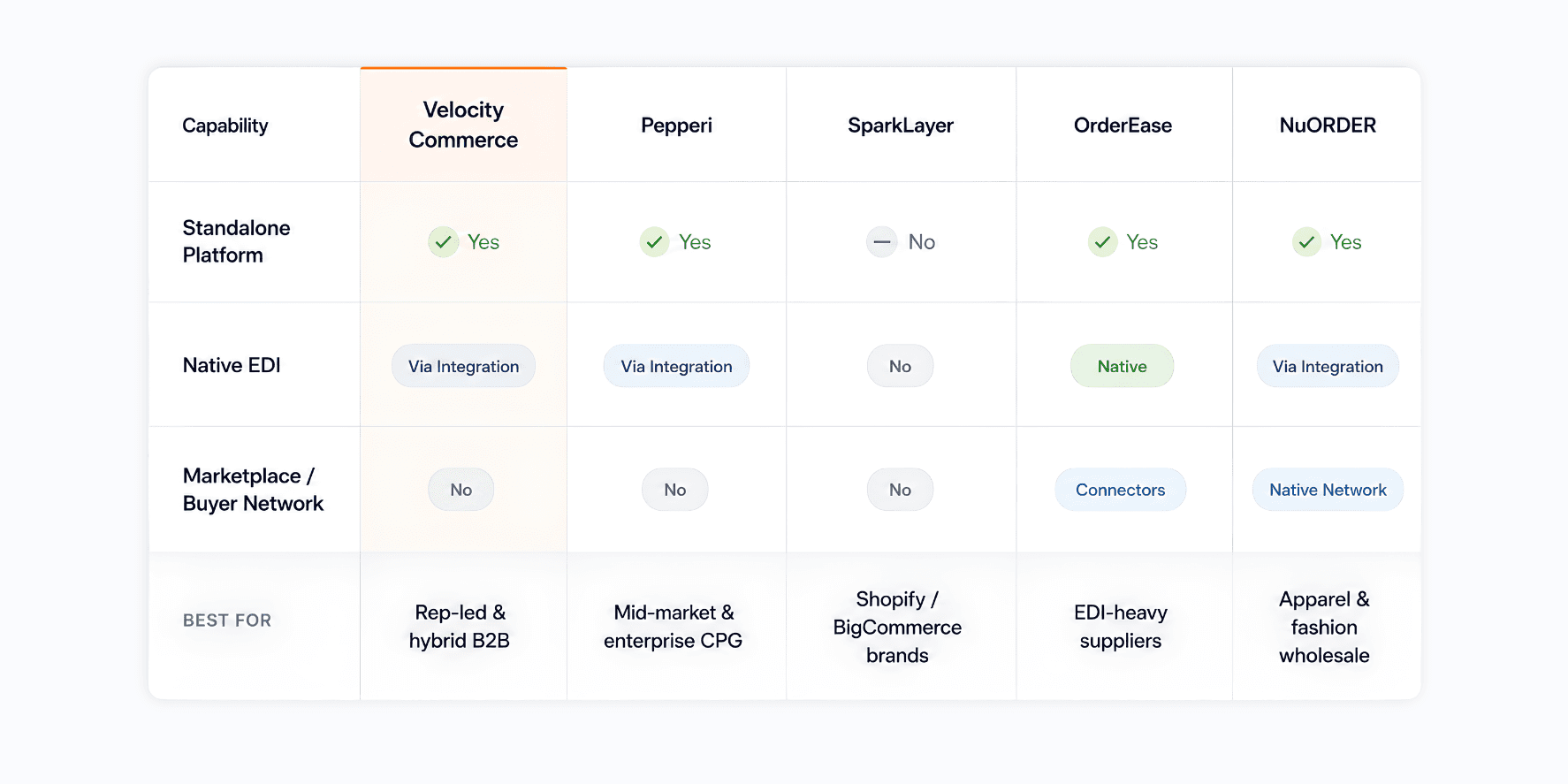
This table is the fastest way to compare the platforms at a glance. Velocity entries are confirmed against the product. Competitor entries are drawn from public sources and are being verified and dated before publishing.
Capability | Velocity Commerce | Pepperi | SparkLayer | OrderEase | NuORDER |
|---|---|---|---|---|---|
Unifies field, ecommerce, and customer service orders | Yes (field, ecommerce, customer service) | Yes (field, inside sales, ecommerce, DSD) | Partial (self-service plus sales agent ordering) | Yes (reps, EDI, portals, ecommerce, email) | Partial (wholesale ecommerce plus rep tools) |
Order-to-rep-attribution | Yes (Automatic, by ZIP and location rules, across up to 6 hierarchy layers) | Partial (Orders tied to the rep who places them) | Partial (Sales Agent orders tied to the agent) | Partial (Orders tied to the rep who places them) | Partial (Orders tied to the rep who places them) |
ZIP-level territory mapping | Yes (ZIP and location overrides) | Limited | No | Limited | No |
Sales rep mobile ordering app | Yes (mobile rep portal) | Yes (iOS and Android, offline) | Sales Agent portal (web) | Yes (offline-ready) | Rep selling tools and linesheets |
Automated commission management | Yes (built-in, up to 6 hierarchy layers) | Not a core feature | Not a core feature | Not a core feature | Not a core feature |
B2B self-service customer portal | Yes (buyer self-service) | Yes | Yes | Yes | Yes (buyer ordering) |
Stored B2B payments (ACH and cards, terms, credit limits) | Yes (via Stripe) | Via payment gateway integration | Net terms and pay on account | Terms synced from ERP | Via integration |
Shopify and BigCommerce fit | Native Shopify app and BigCommerce; also WooCommerce, Wix, standalone | Integrates via IPaaS | Installs on Shopify, BigCommerce, Wix | Connectors, ERP-first | Tied to the Lightspeed ecosystem |
Standalone platform option | Yes | Yes | No (sits on a storefront) | Yes | Yes |
Native EDI document exchange (850, 856, 810) capability | Via integration | Via integration | No | Yes, core strength | Via integration or POS |
Wholesale marketplace or retailer network | No (direct selling model, not a marketplace) | No | No | Marketplace connectors | Yes, core (large buyer network) |
Best for | Rep-led and hybrid multi-channel B2B | Mid-market to enterprise CPG | Brands already on Shopify or BigCommerce | Suppliers with heavy EDI needs | Apparel and fashion wholesale |
What is Velocity Commerce
Velocity Commerce is a B2B order management platform that gives rep-led and multi-channel sellers a single source of truth for every order. Orders from field reps, ecommerce, and customer service are captured in one system and automatically assigned to the correct sales rep, so pricing, commissions, inventory, and customer data stay aligned across every channel.
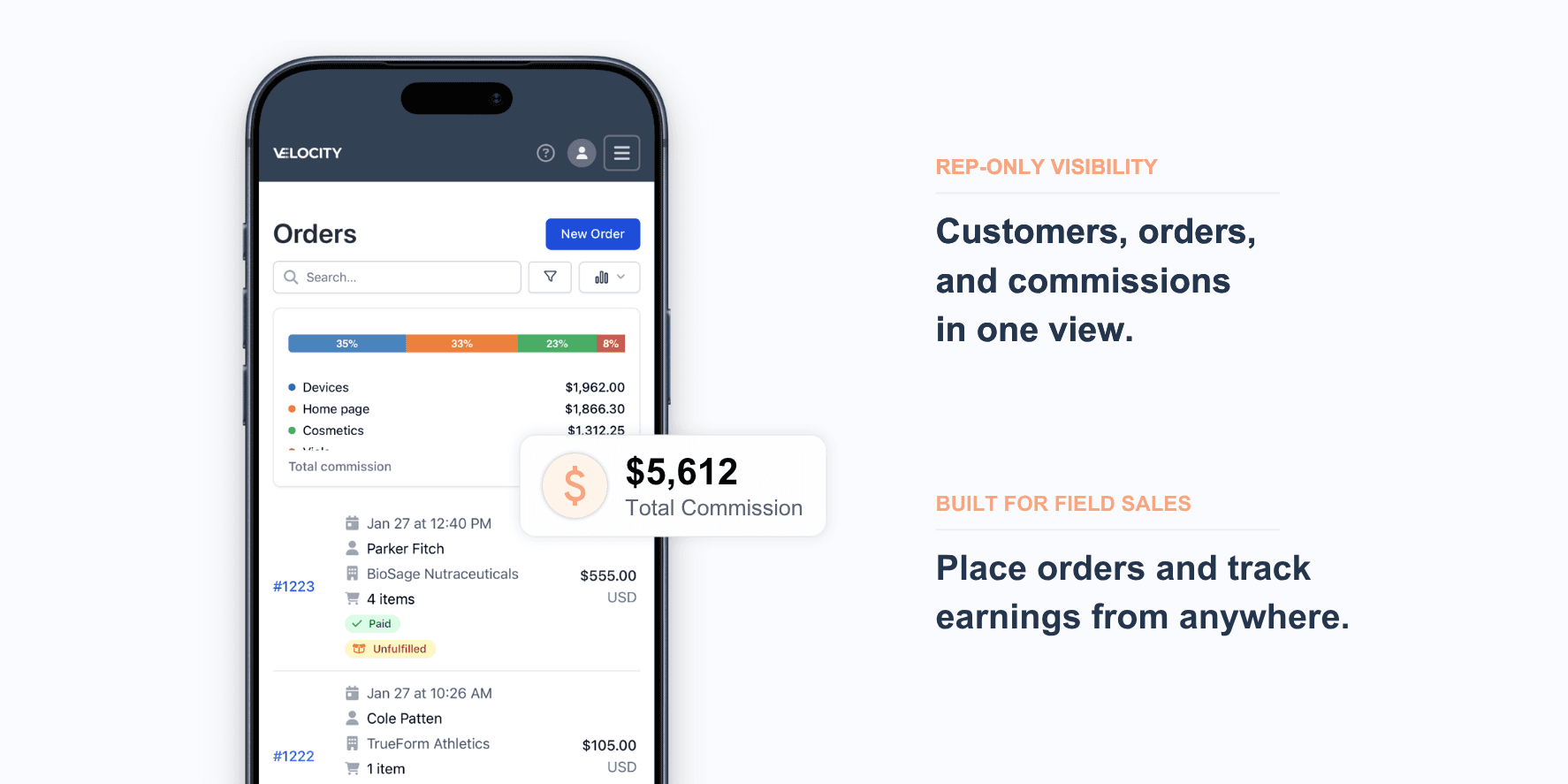
Territory mapping and commission management sit at the center of the product. Velocity maps customers and orders across a sales hierarchy of up to six layers, automates commission calculations, and controls each rep’s visibility by territory. One senior executive who reviewed the product called it the first tool he had seen that combines ZIP codes and location overrides inside Shopify, which speaks to how specific the territory logic gets. Learn more in our guide to sales commission management and our overview of the best order management system for B2B.
The sales rep side runs through a dedicated mobile portal. Reps can onboard new customers, place a first order in minutes, see only their own customers, orders, and commissions, and use saved customer payment methods at checkout. Learn more about that workflow in our roundup of the best sales rep app options for B2B teams.
Velocity also stores customer ACH and card details through its Stripe integration, allowing reps and buyers to place orders on the fly with terms and credit limits already in place. On Shopify, stored payments require Shopify Plus. Because Velocity runs as a native Shopify app, a BigCommerce integration, or a standalone platform that also supports WooCommerce and Wix, teams adopt it without rebuilding their existing commerce stack.
Today, the platform has processed more than 76,500 orders for around 1,000 users, reinforcing its focus on B2B teams that rely on rep ordering, commissions, and order-to-cash workflows.
Velocity vs Pepperi
Pepperi is a unified B2B commerce platform built for consumer goods manufacturers and distributors, mostly mid-market to enterprise. It combines a B2B ecommerce storefront, a mobile order-taking app for field reps, trade promotions, retail execution, route accounting for van sales, and it connects to ERP systems through its own integration service. For a large consumer goods operation running field merchandising and van routes, Pepperi is deep and capable.
Both platforms unify rep ordering, ecommerce, and inside sales, both give buyers a self-service portal with account-specific pricing, and both sync to an ERP. On the surface, the two platforms cover similar ground for multi-channel sellers.
The biggest difference is where each platform places its emphasis. Velocity centers on rep-led and hybrid selling instead of van sales and in-store execution, treating commission management and ZIP-level territory mapping as core features rather than separate modules. Velocity also ships as a native Shopify app and a BigCommerce integration, allowing teams to add B2B ordering without a complex implementation while including stored B2B payments, customer-specific terms, and credit limits out of the box.
Choose Pepperi if you run direct store delivery, field merchandising, and complex trade promotions across a large consumer goods business. Choose Velocity if your priority is unifying field, ecommerce, and customer service orders while managing commissions, territories, and payments in one place, especially on Shopify or BigCommerce.
Velocity vs SparkLayer
SparkLayer adds a full B2B experience on top of an existing Shopify, BigCommerce, or Wix store, and it does that job well for a low monthly cost. More than 3,000 brands use it for customer-specific pricing, net terms, self-service ordering, a quoting engine, and a Sales Agent portal that lets reps place orders for buyers. For a brand that already sells on Shopify and wants wholesale ordering quickly, SparkLayer is a strong, affordable option, and it is one we cover in our guide to Shopify B2B rep ordering.
The two platforms overlap most in Shopify B2B. Both let reps order on behalf of customers, support tiered and customer-specific pricing, and provide buyers with a self-service portal.
The difference is the scope of what each platform is designed to solve. SparkLayer builds on your existing storefront, focusing primarily on self-service ecommerce while relying on the underlying platform. Velocity serves as the system of record for the entire order operation, with built-in commission management, ZIP-level territory mapping, stored ACH and card payments with credit limits, and the flexibility to run as a standalone platform instead of on top of an existing storefront. SparkLayer's Sales Agent tool focuses on placing orders, while Velocity's rep portal also manages territories and calculates commissions.
Choose SparkLayer if you are committed to Shopify, BigCommerce, or Wix and want B2B self-service added at a low price. Choose Velocity if you need commission management, territory control, and stored B2B payments in one system – or if you want a platform that is not tied to a single storefront.
Velocity vs OrderEase
OrderEase is a B2B order management system built around EDI and big-retailer compliance. It pulls orders from reps, EDI feeds, customer portals, ecommerce, marketplaces, and emailed purchase orders into one workflow, then syncs them cleanly into an ERP such as NetSuite, QuickBooks, or Sage. For a supplier that has to trade with large retailers and keep every channel ERP-ready, OrderEase is purpose-built for that complexity.
Both share the same core promise, which is a single source of truth for multi-channel B2B orders. Both standardize orders from several channels, give buyers a branded ordering portal, and offer an offline-capable field app.
Their priorities are what set them apart. OrderEase focuses on order orchestration, EDI automation, and retailer compliance, making it strongest when trading-partner mandates and ERP routing drive the work. Velocity focuses on the selling side of the same problem, with rep enablement, automated commissions, territory mapping, stored B2B payments, and native Shopify and BigCommerce integrations. One is optimized for operations and EDI workflows, while the other is optimized for rep-led selling and order-to-cash.
Choose OrderEase if EDI compliance and big-retailer trading are central to your business. Choose Velocity if your orders come mainly through reps, your own ecommerce, and customer service, and you want commissions and territory handled in the same platform.
Velocity vs NuORDER
NuORDER by Lightspeed is a wholesale commerce platform for brands that sell to retailers, with deep roots in fashion, apparel, and footwear. It pairs a branded wholesale website with digital linesheets, virtual showrooms, assortment planning, and a large buyer network that connects brands with retailers, and it integrates with Lightspeed's retail point of sale. For an apparel brand selling into wholesale accounts, NuORDER offers reach and merchandising tools that are hard to match.
Both platforms overlap in account-based B2B ordering. Both support buyer-specific pricing and product visibility, provide a branded ordering experience, and equip reps with selling tools.
From there, the platforms take very different approaches. NuORDER is built around a brand-to-retailer network tied to the Lightspeed ecosystem, with a strong fashion and seasonal-buying orientation. Velocity is platform-agnostic and built for rep-led, direct B2B selling across industries, with commission management, territory mapping, and stored B2B payments at its core instead of a wholesale marketplace. If your business depends on selling through a retailer network, NuORDER is the better fit. If your business depends on direct selling through your own reps and channels, Velocity is the stronger choice.
Choose NuORDER if you are a fashion or apparel brand that wants a wholesale network and assortment planning. Choose Velocity if you sell directly through reps, ecommerce, and customer service, and you want commissions, territory, and payments unified without ecosystem lock-in.
When Velocity is the Right Fit, and When it is Not
Velocity is the strongest fit for rep-led and hybrid B2B teams that want one platform for field, ecommerce, and customer service orders. That includes manufacturers, distributors, wholesalers, and multi-channel B2B brands that need commissions, territory rules, and stored B2B payments working together, with the flexibility to run on Shopify, BigCommerce, WooCommerce, Wix, or as a standalone platform.
It isn’t the right fit for every scenario, and that’s worth stating plainly. Brands whose primary goal is selling through a wholesale retailer network will get more from NuORDER, while suppliers built around EDI compliance with big-box retailers will be better served by OrderEase. Teams that simply want an affordable way to add B2B self-service to an existing Shopify store should consider SparkLayer. Velocity is the stronger choice when reps, commissions, and territory management are central to how you sell.
Final Thoughts
These five platforms are not really competing for the same buyer. Each one serves a different type of B2B seller, so the real question is which description matches your business. Pepperi suits large consumer goods operations, SparkLayer suits Shopify-first brands wanting self-service, OrderEase suits EDI-heavy suppliers, and NuORDER suits apparel wholesalers.
Velocity Commerce is built for the rep-led, multi-channel seller that wants field, ecommerce, and customer service orders unified, with commissions, territory management, and payments handled in one place. If that sounds like your business, the fastest way to evaluate fit is to see Velocity run on your own orders.
FAQ
What is the best B2B order management platform for sales reps?
The best fit depends on how your reps sell. For rep-led teams that need a mobile ordering portal with built-in commissions and territory rules, Velocity Commerce is purpose-built for that work. Pepperi is a strong choice for large consumer goods teams that also run van sales and retail execution.
Velocity vs Pepperi: which is better for a distributor?
Pepperi fits distributors that need direct store delivery, route accounting, and trade promotions at the enterprise level. Velocity fits distributors that want field, ecommerce, and customer service orders unified, with automated commissions and territory mapping, and a native Shopify or BigCommerce option.
Is SparkLayer or Velocity better for a Shopify B2B store?
SparkLayer is a low-cost way to add B2B self-service on top of a Shopify store and works well for that. Velocity is the better fit when you also need rep commissions, territory control, and stored B2B payments in the same system, or you want the option to run beyond a single storefront.
What is the best alternative to NuORDER for non-apparel B2B?
NuORDER is built around fashion and apparel wholesale through a retailer network. For non-apparel, rep-led B2B selling across many verticals, Velocity Commerce is a closer fit, since it centers on direct rep ordering, commissions, territory, and B2B payments rather than a wholesale marketplace.
Does Velocity handle commissions and territories?
Yes. Velocity includes automated commission management across a sales hierarchy of up to six layers, and it maps customers and orders by territory using ZIP and location rules. Orders are assigned to the correct rep automatically, and reps see only their own customers, orders, and commissions.
How does Velocity pricing work?
You can view pricing options and download Velocity Commerce from the Shopify App Store to get started (free to install), or schedule a demo to explore a more customized, standalone instance of Velocity Commerce (for those using other e-commerce platforms, or no e-commerce at all).