
Sales Commission Management: A Practical Guide for B2B Sales Teams

Your top sales rep hit quota three weeks ago. The check still hasn't landed. By the time it finally arrives, they've already replied to a recruiter on LinkedIn.
That's the real cost of broken sales commission management. Slow payouts, unclear calculations, and territory disputes don't just frustrate reps. They chip away at trust, disrupt forecasts, and quietly slow growth.
This guide breaks down what sales commission management actually is, why it stalls B2B teams as they scale, and how to graduate from spreadsheets to a system that pays accurately and on time.
INDEX
What Is Sales Commission Management?
Why It Matters More Than Most Sales Leaders Admit
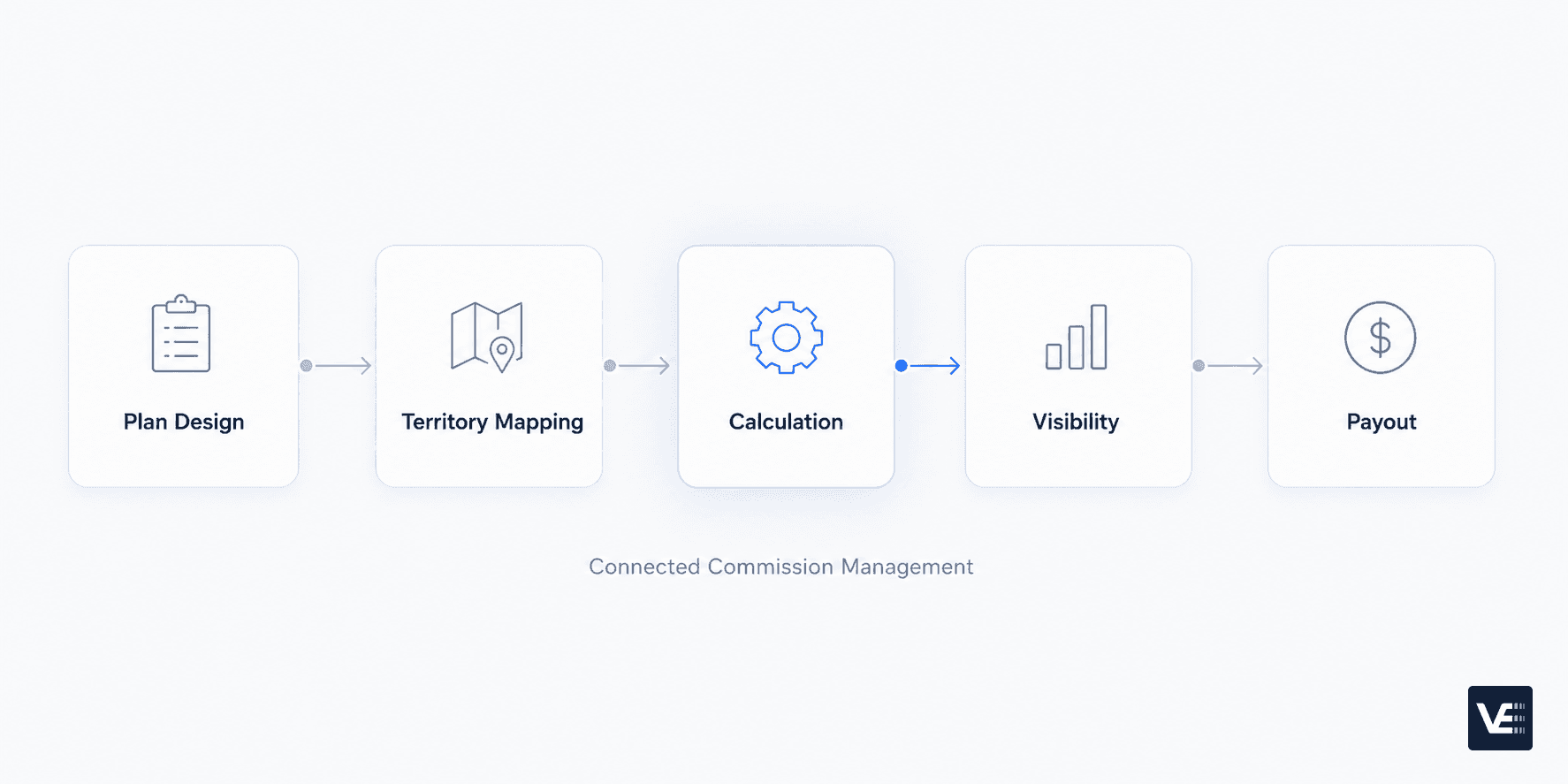
The Core Components of Sales Commission Management
The Five Challenges That Break Commission Management at Scale
How to Manage Sales Commissions Effectively: A 5-Step Approach
Manual vs. Automated: When You've Outgrown the Spreadsheet
What to Look for in Sales Commission Management Software
Where Commissions Meet Order Management
FAQs
How do you manage sales commissions effectively?
How much commission does a salesperson make on a $30,000 sale?
What is a 70/30 split in sales compensation?
What's a good commission structure for B2B sales teams?
What Is Sales Commission Management?
Sales commission management is the end-to-end process of designing, calculating, tracking, and paying out commissions to sales reps. It connects sales activity to compensation through a defined commission plan, which dictates who earns what, when, and on which deals.
It sounds simple. In practice, it rarely is.
A working commission process touches at least four systems: your CRM (where deals live), your order management or billing platform (where revenue gets recognized), your finance stack (where payouts get approved), and your payroll provider (where money actually moves). When those systems don't sync properly, commission management turns into a manual cleanup job for someone who’s already overloaded.
Done well, it gives reps real-time visibility into earnings, gives finance a clean view of compensation costs, and gives leadership a lever to steer behavior toward the revenue outcomes that matter most.
Why It Matters More Than Most Sales Leaders Admit
Commission plans shape behavior.
Reps read commission plans the same way pilots read weather radar. The plan tells them where to spend energy, which deals to chase, and which to deprioritize. So when your commission management is messy, you're not just paying people late. You're sending mixed signals about strategy.
A few realities worth knowing:
Roughly 70% of businesses still run commissions on spreadsheets. The error rate compounds with every new plan, rep, or territory layer added on top.
Commission mistakes aren't a small leak. 66% of companies lose between 1% and 9% of their salesforce to commission errors every one to two years. That’s rep churn caused by accounting mistakes.
Reps who can't see how their commissions are calculated mentally discount future earnings. They sell less aggressively. They start looking elsewhere.
The stakes scale with you. A team of five with one comp plan? A spreadsheet survives. A team of 30 across three territories, two product lines, and a six-layer hierarchy? You've already lost the plot.
The Core Components of Sales Commission Management
1. Plan Design
The commission plan defines the rules of the game. Rates, accelerators, quotas, draws, bonuses, clawbacks. Plan design is where strategy gets encoded into math. Get this wrong, and no amount of automation downstream will save you.
2. Territory and Hierarchy Mapping
Who owns which customer? Which rep gets credit when an order comes in from a hospital that sits across two reps' territories? Who earns the override when a deal closes inside a regional manager's patch?
B2B sales teams with field reps, channel partners, or multi-layer hierarchies live or die by this layer. Get the mapping wrong, and you'll burn a Friday afternoon every month resolving attribution disputes.
3. Calculation Engine
This is the math. The system pulls deal data, applies plan rules, factors in accelerators or tier thresholds, and produces a number. Done manually, it takes hours per rep. Done well, it takes seconds and shows the work.
4. Visibility and Tracking
Reps need to see what they've earned, what's pending, and what's at risk. Real-time dashboards reduce constant "Where's my commission" Slack pings and rebuild trust faster than any all-hands meeting.
5. Payout and Reporting
Approvals, payroll handoff, and the analytics that tell leadership which plans are driving which behaviors. This is where finance and RevOps either sleep well or don't.
If any one of these five pieces lives in a spreadsheet while the others sit in software, you don't have a system. You have a handoff problem. We dug into this dynamic in more depth in our piece on connecting reps, orders, and commissions in B2B.
The Five Challenges That Break Commission Management at Scale
Here's where it gets messy.
Manual processes
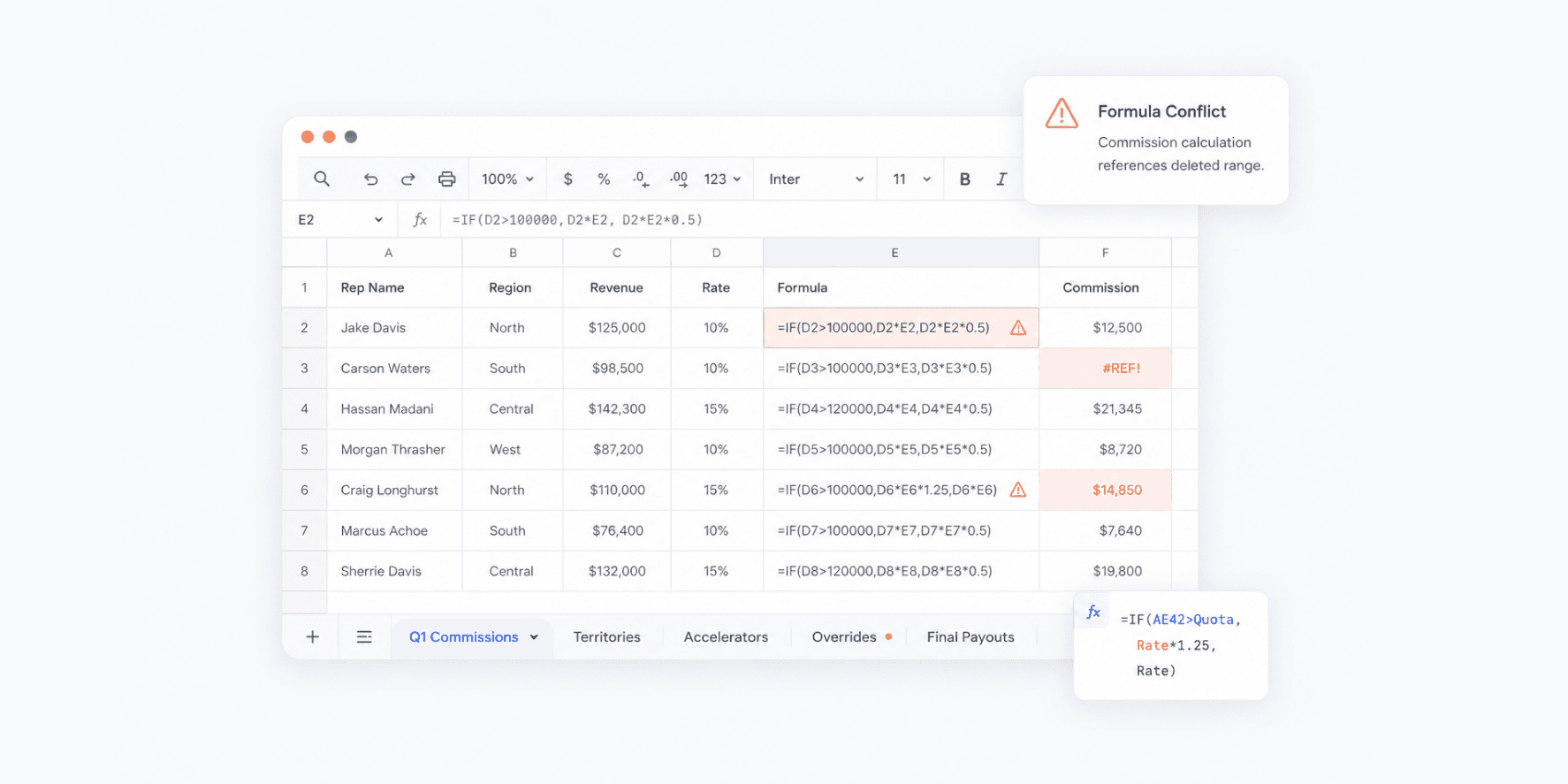
Spreadsheets work until they don't. A small plan change ripples through 14 tabs. One typo can wipe out accelerator earnings for three reps. By the time you catch it, payouts have already gone out.
Plan complexity
Leadership wants to incentivize five different behaviors at once. So the plan adds tiers, splits, kickers, and a SPIF on top. Suddenly, nobody understands their own comp plan, including the people who built it.
Territory disputes
In B2B, especially with field reps, territory mapping rarely matches reality. Reps overlap. Accounts move. New regions get carved out mid-year. Without a clear single source of truth, every disputed deal creates additional friction between teams.
Lack of visibility
Reps don't trust systems they can't see into. When commission calculations live in a closed spreadsheet, only Ops touches, every payout becomes a question of faith.
Payout delays
Late commissions are the fastest way to break a great salesperson. They've already mentally spent it. When it doesn't show up, they start to wonder what else the company gets wrong. And the longer the gap, the more those questions compound. (We covered the upstream version of this problem in our breakdown of B2B order management challenges as businesses scale.)
How to Manage Sales Commissions Effectively: A 5-Step Approach
A workable process, whether you're running it manually or with software.
Step 1: Tie the Plan to a Single North-Star Metric
Start with the metric your business cares about most. ARR. New logos. Gross margin. Multi-year contracts. Whatever it is, the commission plan should clearly reward it. If a rep can't explain the goal of the plan in one sentence, it’s too complex.
Step 2: Map Roles to Compensation, Not the Other Way Around
An account executive closing six-figure enterprise deals shouldn't be on the same plan structure as an inside sales rep booking meetings. Different roles, different priorities, different math. Layer in overrides for managers and channel reps separately, with clear caps so commission stacking doesn't quietly eat margin.
Step 3: Lock Down Territory and Hierarchy Logic
Before launching the plan, define who owns what. Zip codes, account lists, named accounts, channel splits, and manager rollups. Write it down. Stress-test it with three messy hypothetical deals. Better to find the cracks now than during a payout dispute in week six.
Step 4: Make Calculations Transparent
Whatever tool you use, reps should be able to click a deal and see exactly: which plan applied, what the base rate was, which accelerator kicked in, and how the final number was reached. No black boxes. Transparency reduces disputes faster than perfection ever will.
Step 5: Pay On Time. Always.
Pick a cadence. Stick to it. A reliable monthly payout beats an irregular weekly one every single time. Every payout that slips erodes trust geometrically. If you can't hit the date, communicate before the date, not after.
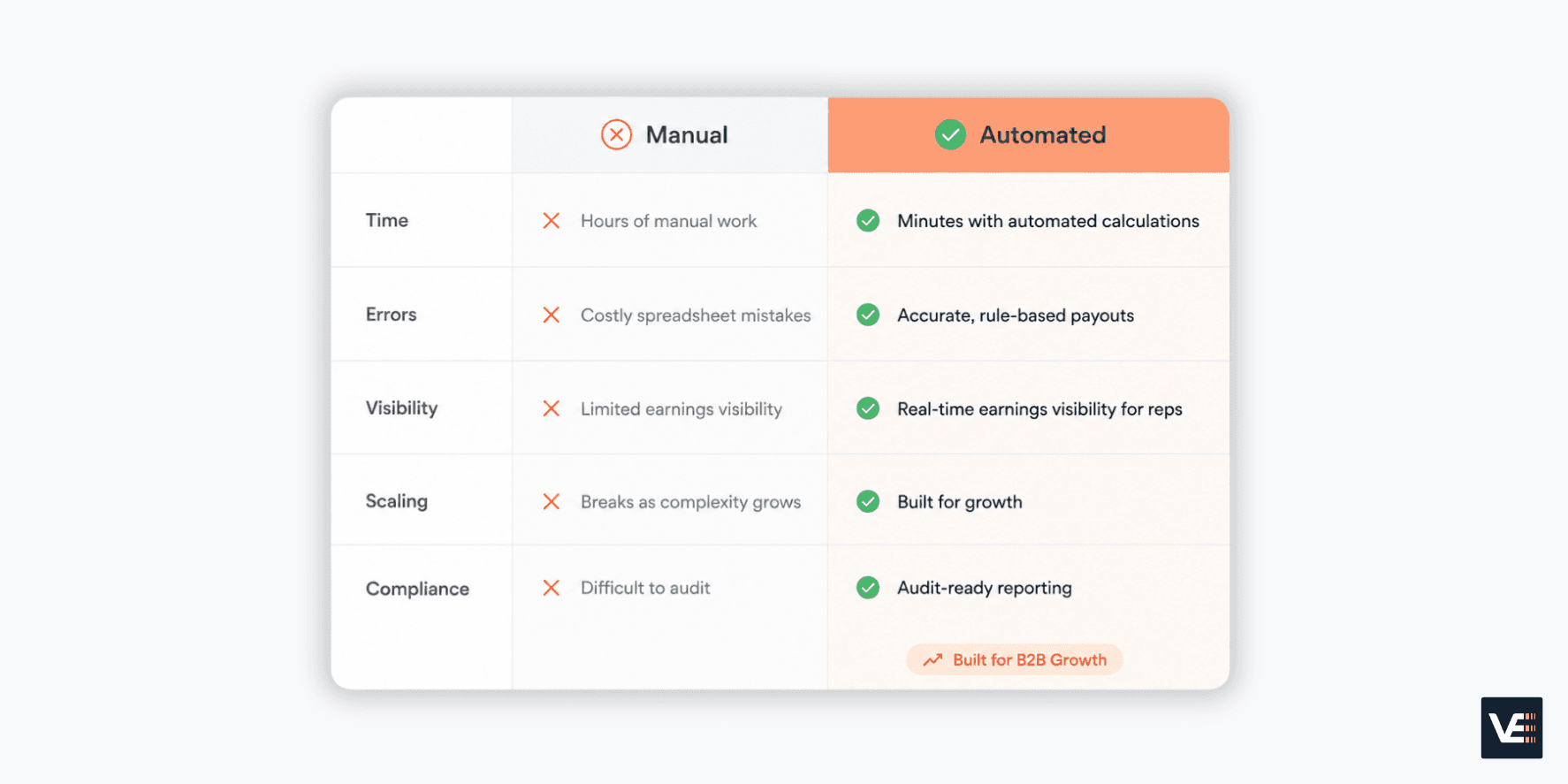
Manual vs. Automated: When You've Outgrown the Spreadsheet
There's no shame in starting with a spreadsheet. Most teams do. The question is when to graduate.
You've outgrown manual commission management when:
More than one person needs to touch the commission file every cycle
You have more than two commission plans running at once
Territory or hierarchy mapping requires its own tab
Reps regularly ask Ops to "double check" their numbers
You've personally lost a weekend to commission math in the last quarter
Once any two of those are true, the math has shifted. The cost of the spreadsheet (your time, your errors, your rep churn) now exceeds the cost of a tool.
What to Look for in Sales Commission Management Software
A tight evaluation checklist. Use it to score vendors honestly:
Clean integration with your CRM, billing platform, and payroll provider
Support for your full territory and hierarchy logic, including overrides for managers and channel partners
A self-serve rep dashboard with real-time earnings, not just a static report
Plan modeling against historical data so you can stress-test changes before rolling them out
An audit trail finance can hand to an auditor without flinching (think ASC 606 compliance)
Pricing that scales with usage in a way that won't surprise you at renewal
Realistic implementation timelines based on customer outcomes, not just vendor promises
If a tool can't handle your B2B reality (multi-channel orders, field reps, territory layers, customer-saved payment methods), you'll be back to spreadsheets in six months. Our team also put together a deeper guide on the best apps for sales reps covering the broader category.
Where Commissions Meet Order Management
Here's the part most commission tools miss.
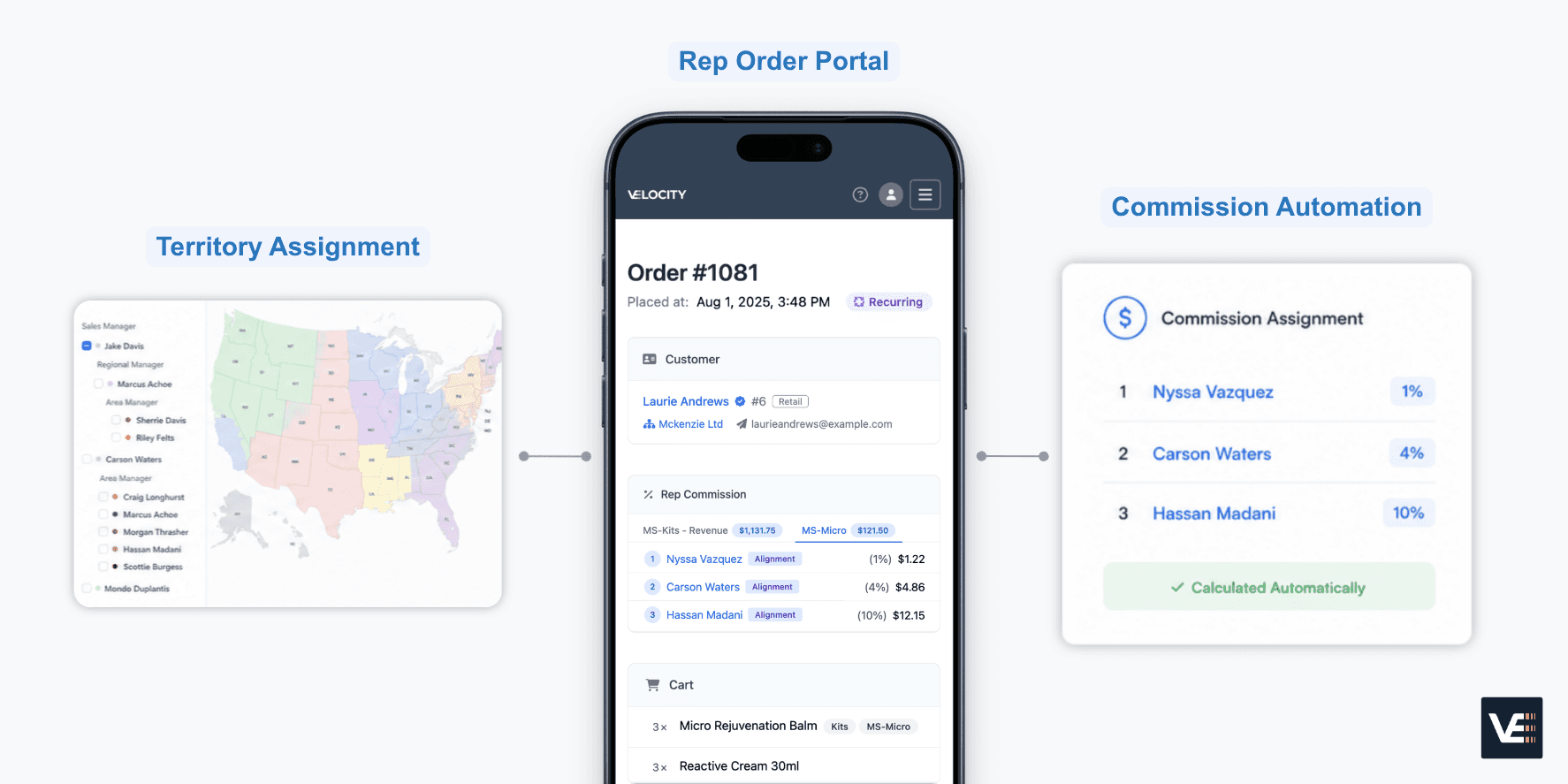
In a B2B operation, commission math doesn't start with the deal. It starts with the order. A field rep places one order through a mobile portal. Ecommerce captures another from the same customer. Customer service enters in a third manually. If your commission system doesn't know which rep owns which order, the math is already wrong before it runs.
That's the gap Velocity Commerce is built for. By connecting order management and commission automation into a single platform, Velocity assigns orders to the right rep automatically based on territory mapping (up to six layers of hierarchy), then feeds clean commission data forward. No more reconciling order systems against commission spreadsheets. No more disputes about who closed what.
For teams selling through Shopify, BigCommerce, or other B2B storefronts, that connected layer is what makes commissions actually trustworthy. Reps see only their customers and orders. Managers see their rollups. Finance sees clean accruals. One shared source of truth. (Our team broke down a Shopify-specific version of this workflow in From Rep Orders to Clean Commission.)
If your order management and commission systems live in separate worlds today, the friction you're feeling isn't your team's fault. It's a tooling gap. (For broader context on the upstream side, see What is Order Management?)
Final Thoughts
Sales commission management isn't a back-office function. It's a growth lever disguised as accounting work.
Pay accurately, pay on time, make the math visible, and you'll see it show up in retention, in pipeline aggression, in the confidence reps bring to forecast calls. Get it wrong, and you're spending the same money to reinforce the wrong behaviors.
The fix isn't more spreadsheets. It's a system that connects orders, territories, and payouts into one source of truth.
See how Velocity Commerce unifies order management and commission automation for B2B teams.
FAQs
How do you manage sales commissions effectively?
Start with a plan that maps cleanly to one business goal, automate the calculation so errors don't compound, and give reps real-time visibility into earnings. For B2B teams with field reps or multi-channel orders, a platform that ties order management to commission logic eliminates the disputes that derail manual processes. Pay on a reliable cadence and treat commission accuracy as a retention metric, not just an accounting one.
How much commission does a salesperson make on a $30,000 sale?
It depends on the industry and structure, but in B2B sales a flat commission rate typically lands between 5% and 15% of deal value. On a $30,000 sale, that's roughly $1,500 to $4,500. Many plans layer in accelerators that lift the rate once reps pass quota, so the effective commission on a $30,000 deal can climb significantly higher for top performers. Industries vary widely. Car sales, real estate, and SaaS each apply different conventions.
What is a 70/30 split in sales compensation?
A 70/30 split refers to the ratio of base salary to variable commission in a rep's on-target earnings (OTE). 70% comes from base pay, 30% from commission tied to performance. It's a common structure for roles where the rep has significant control over outcomes but the company still wants stability built in. Account executives often sit on a 50/50 or 60/40 split. SDRs and sales engineers more typically land on 70/30 or 80/20.
What's a good commission structure for B2B sales teams?
There's no single right answer, but the best structures share three traits. First, they tie clearly to one or two business metrics, not five. Second, they reward both effort (activity-based bonuses for SDRs) and outcomes (deal-based commissions for AEs). Third, they include accelerators above quota so top performers have a reason to push past the line. For complex B2B teams with territories and multi-layer hierarchies, the structure also needs an underlying system that can handle the math without breaking.