Point of Sale Financing: How Approvals Happen Before the Rep Leaves the Room


Most explanations of point of sale financing describe a retail checkout. A shopper picks a $900 item, taps a button, splits the cost across four payments, and leaves. That model is well documented and easy to understand.
Bringing that same point of sale experience to a $60,000 equipment sale is documented far less. The applicant is a business rather than a shopper, guarantors sign personally, the purchase is capital rather than discretionary, and the sales conversation happens in a customer’s office instead of at a counter. The mechanics are different at almost every step, and traditional equipment financing can add significant time and manual work to the process. A financing decision that arrives while the representative is still in the room keeps momentum. One that arrives four days later gives the customer time to reconsider, evaluate other options, or defer the purchase to a future budget cycle.
This guide covers how point of sale financing works in B2B equipment sales, what happens at each stage of an application, and what separates fast automated decisions from applications that require manual review.
| TL;DR: Point of sale financing is credit arranged during a purchase rather than before it. In consumer retail it usually means a small installment plan completed at checkout. In traditional B2B equipment sales, financing typically involves larger purchase amounts and can mean longer approval timelines and manual paperwork. Velocity Lending brings point of sale financing directly into that sales process, using soft credit checks and automated underwriting to return decisions in under a minute. Approval speed depends largely on data accuracy, guarantor credit, and whether the purchase falls inside pre-configured ranges. |
What Point of Sale Financing Means
Point of sale financing is credit arranged during the purchase itself, rather than separately beforehand. The buyer applies while the transaction is in progress, a finance provider underwrites the application, and the seller receives payment while the buyer repays over an agreed schedule. Nothing about that definition specifies a purchase size or buyer type, which is why the same concept can apply to two very different transactions.
In consumer retail, point of sale financing usually appears as an installment plan for purchases ranging from a few hundred to a few thousand dollars. Approval typically depends on the shopper’s personal credit, and the merchant generally pays a percentage fee on the transaction.
In business equipment sales, the applicant is a business. Purchases tend to fall between $10,000 and several hundred thousand dollars, one or more owners sign as guarantors, and the agreement is a financing contract with a payment schedule rather than a retail installment plan. The financing structure and underwriting are also more complex than those of a typical consumer transaction.
What the two share is a core point of sale concept. Financing is presented as part of the sale rather than as a separate process the buyer handles between meetings. That placement is a key value of point of sale financing: a purchase that waits on outside approval competes with every other item in the buyer’s capital budget.
Consumer Point of Sale Financing vs B2B Equipment Financing
The two applications of point of sale financing differ in who is evaluated, how large the purchase can be, and how long the financing is underwritten. Sellers evaluating providers can run into trouble when they assume a consumer program will stretch to cover capital equipment, because approval limits and underwriting models are built for a different transaction.
| Consumer point of sale financing | B2B equipment financing | |
|---|---|---|
| Who applies | An individual shopper | A business, with owners as guarantors |
| Typical purchase size | $200 to $5,000 | $15,000 to $185,000+ |
| Credit evaluation | Personal credit, requirements vary by provider | Business and guarantor credit; requirements vary by provider |
| Information required | Basic personal and identity details | Business and guarantor information; additional documentation may be required |
| Decision speed | Seconds at checkout | Can take longer depending on the provider and underwriting process |
| Contract | Retail installment agreement | Business financing agreement |
| Cost to the seller | Usually a percentage discount fee | Varies by financing structure and provider |
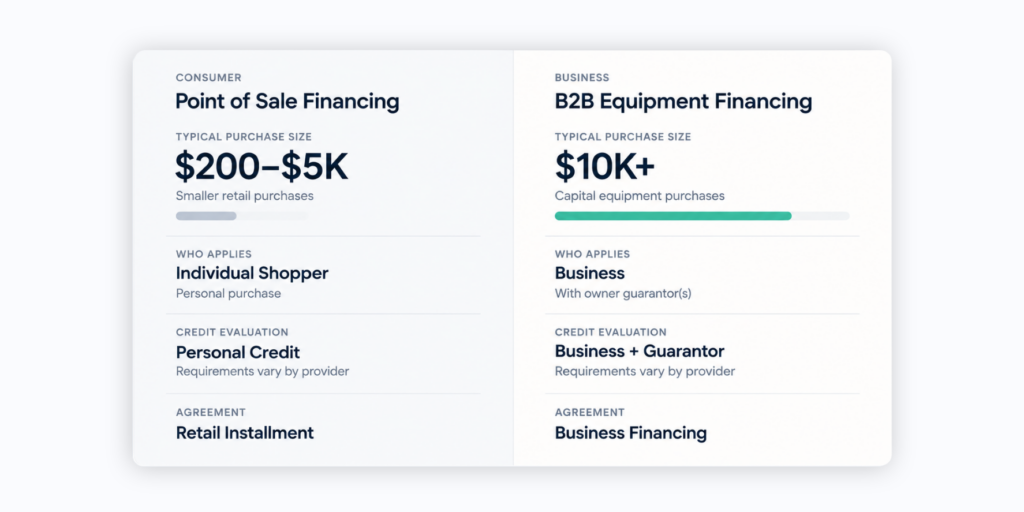
Purchase size is one of the biggest differences in practice. Consumer providers are built around small balances and higher transaction volume, so a $60,000 equipment purchase may fall outside the provider’s limits. Sellers who discover that limit mid-conversation risk losing both the financing option and the customer’s confidence in it.
The information requirement is the other meaningful difference. A consumer application typically requires basic identity information. Business financing can require entity details, tax identification, and personal information from guarantors, which means the representative needs a workflow that can collect it without turning the meeting into a data entry session. B2B purchases already carry more structure than consumer ones, and we cover how that structure shapes the buying process in our guide to B2B checkout requirements.
How a Point of Sale Financing Application Runs in a B2B Sale
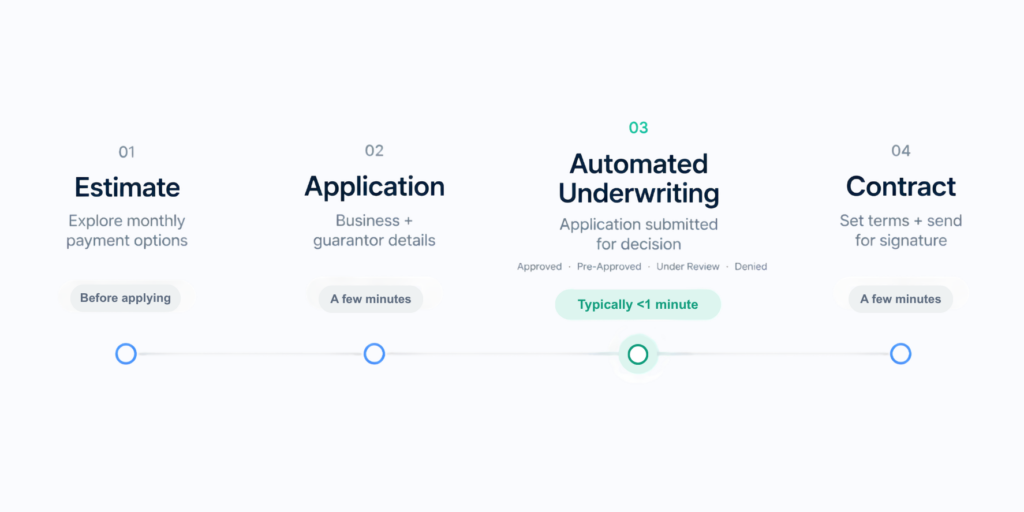
With Velocity Lending, a B2B financing application moves through four stages designed to keep the process moving during the sale. Understanding where the additional review may be needed helps representatives manage the conversation and set clear expectations around timing.
Estimate the payment before anyone applies
The conversation usually starts with a number. A representative can produce a monthly payment estimate from a calculator configured to the seller’s own product catalog, without collecting customer information. Adjusting the down payment or deferred months updates the estimate, so payment options can be explored directly with the customer before anyone commits to an application. Products added to the calculator carry over automatically when the application starts, eliminating a re-entry step.
Estimates reflect the agreement between the finance provider and the selling organization. Approved rates may differ, because final terms depend on factors such as guarantor credit.
Enter business and guarantor details
The application collects the applicant name and role, as well as the business name and address. The business can be searched by name or address to auto-fill those fields. Including the Tax ID is optional but generally improves the odds of approval by giving underwriting a cleaner entity match.
Guarantor information follows: name, phone number, address, date of birth, email, and Social Security number. Up to three guarantors can be added, with one marked as primary. Velocity Lending performs a soft credit check for each guarantor, so applying does not affect anyone’s credit score.
Representatives who prefer not to collect personal information directly can share the application with the customer by email. The customer receives a secure link to complete their portion, with product and pricing details hidden from their view. The application locks while the customer completes it, and the representative is notified by email once it is returned.
Submit for automated underwriting
After submission, Velocity Lending’s automated underwriting reviews the application. A decision typically returns in under a minute, helping keep the sales conversation going. The result comes back as approved, pre-approved, denied, or under review.
Set terms and send the contract
Approved applications move into a short sequence of steps. The approved amount is reviewed, transfer prices are set for each product within the organization’s configured range, and a payment plan is selected from the available options. An optional down payment can also reduce the monthly payment. The contract is then sent for electronic signature, with each guarantor signing before the agreement is completed.
What Determines Whether Approval Happens on the Spot
With Velocity Lending, automatic approval depends on three things: accurate business data, guarantor credit that meets the requirements, and a purchase that fits the configured range. When an application requires additional review, it is generally tied to one of those factors rather than anything the representative did during the meeting.
Business data accuracy. Velocity Lending verifies business information and applicant type during underwriting. If the name and title on the application does not closely match the verified record, the application may pause so the corrected information can be accepted or rejected before evaluation continues. Auto-filled fields should be checked rather than assumed correct, since an outdated address or incorrect entity name can delay an in-room decision.
Guarantor credit. Approval is based on an evaluation that considers operational history alongside the credit profile of the guarantors. If a guarantor’s credit profile falls short of the requirement, the application moves to an “Awaiting Guarantors” status, allowing additional guarantors to be added. That path remains open, but it may extend the decision beyond the initial meeting.
Supporting documents. Some applications require additional review before they can be approved. When that happens, the application moves to “Awaiting Documents” and bank statements may be requested. After the documents are submitted, it goes under manual review, with a response generally arriving within 1 business day. While this would move the deal close to a follow-up call, it is still fast by equipment financing standards.
Purchase size and configuration. Each product carries a range of valid transfer prices configured in advance. Deferral options also vary by organization. Both are set up before applications are submitted, giving representatives clear parameters for the financing options available on each deal.
The practical takeaway for sales leadership is that Velocity Lending equips sales teams with fast, automated financing decisions directly at the point of sale, helping reps keep deals moving while they’re still with the customer. While the technology enables that speed, complete and accurate application information matters. Clean customer records, Tax IDs captured upfront, and clear guidance on which guarantors to list can help more applications stay on the automated path.
What Point of Sale Financing Costs the Seller
Cost structures fall into two broad models, and they are not directly comparable. Consumer point of sale providers commonly charge the merchant a discount fee calculated as a percentage of the transaction, deducted before the merchant is funded. The fee is visible, predictable, and scales with the size of the sale.
Programs built around equipment sales often work differently. In a transfer price structure, the finance provider purchases the product from the seller at an agreed price and finances it for the customer. We compare the available financing structures, including in-house terms and leasing, in our guide on how to offer financing to customers.
One clarification is useful here, because the two terms get confused constantly. PO financing is purchase order financing, a working capital product in which a funder advances money to a supplier so it can fulfill a confirmed order, typically for a monthly fee on the advanced amount. POS financing is credit extended to the buyer at the point of purchase. They sit on different sides of the transaction and solve different problems.
Where Velocity Lending Fits
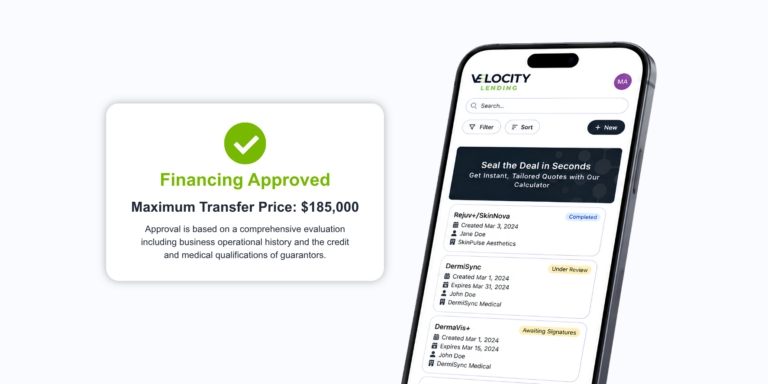
Velocity Lending puts the B2B financing process in the hands of sales representatives at the point of sale, allowing them to generate estimates, submit applications, receive fast financing decisions, send contracts, and move toward closing the deal in a single visit rather than across days of back and forth.
Three parts of Velocity Lending directly address that friction. The calculator produces payment estimates from the seller’s own catalog without requiring customer information, so financing can be discussed early without a commitment. Velocity Lending uses soft credit checks on guarantors, so applying does not affect their credit score. Automated underwriting typically returns a decision in under a minute, allowing the representative to adjust terms while they’re with the customer.
Final Thoughts
Point of sale financing is often presented as a conversion tactic for consumer checkout. For B2B equipment purchases, the more useful question is how much time sits between customer interest and a financing decision. The longer that gap lasts, the more opportunity there is for the purchase to lose momentum.
Sellers evaluating a financing platform should consider approval speed an operational KPI, not just a financing feature. Accurate customer records, complete guarantor information, and a properly configured catalog can all shorten the path to a decision.
If you sell equipment or devices and want to see how Velocity Lending equips reps to offer fast financing decisions right at the point of sale, talk to our team.
FAQs
Point of sale financing means credit that is arranged during a purchase rather than separately beforehand. The buyer applies while the transaction is in progress, a finance provider underwrites the application, and the seller is paid while the buyer repays over an agreed schedule. It covers both small consumer installment plans at retail checkout and financing for business equipment purchases in the tens or hundreds of thousands of dollars.
The buyer submits an application at the moment of the sale, either on a device the seller provides or through a link the seller shares. The provider evaluates the application, which for business financing means checking the entity and running a credit check on the guarantors. Once approved, terms are selected and a contract is signed electronically. Automated underwriting can return a decision in under a minute, though applications that need supporting documents take longer.
That depends on the provider and the check they run. Many consumer point of sale providers perform a hard credit inquiry, which can lower a score slightly and stays on a credit report. Providers that run a soft credit check, including Velocity Lending, leave the score unaffected whether the application is approved or declined. Repayment behavior after the agreement is signed may still be reported, so missed payments can affect credit later.
PO financing, or purchase order financing, is a different product from POS financing. It advances working capital to a supplier so it can fulfill a confirmed order, and it is typically priced as a monthly fee on the amount advanced, often in the range of 1% to 6% per month depending on the funder and the risk. Point of sale financing costs the seller either a percentage discount fee on the transaction or, in a transfer price structure, an agreed reduction in the price the provider pays for the product.
For the seller, financing at the point of sale can shorten the decision cycle, remove the buyer’s capital budget as an immediate obstacle, and allow larger configurations to be considered, since the conversation shifts to a monthly payment. For the buyer, it preserves cash and spreads the cost of equipment across the period in which the equipment generates revenue. The size of the benefit depends heavily on how quickly approvals come back, which is why decision speed is generally the first thing to evaluate in a provider.
See how Velocity fits your B2B team.
Schedule a demo