
B2B Inventory Management: Where It Ends and Order Management Begins
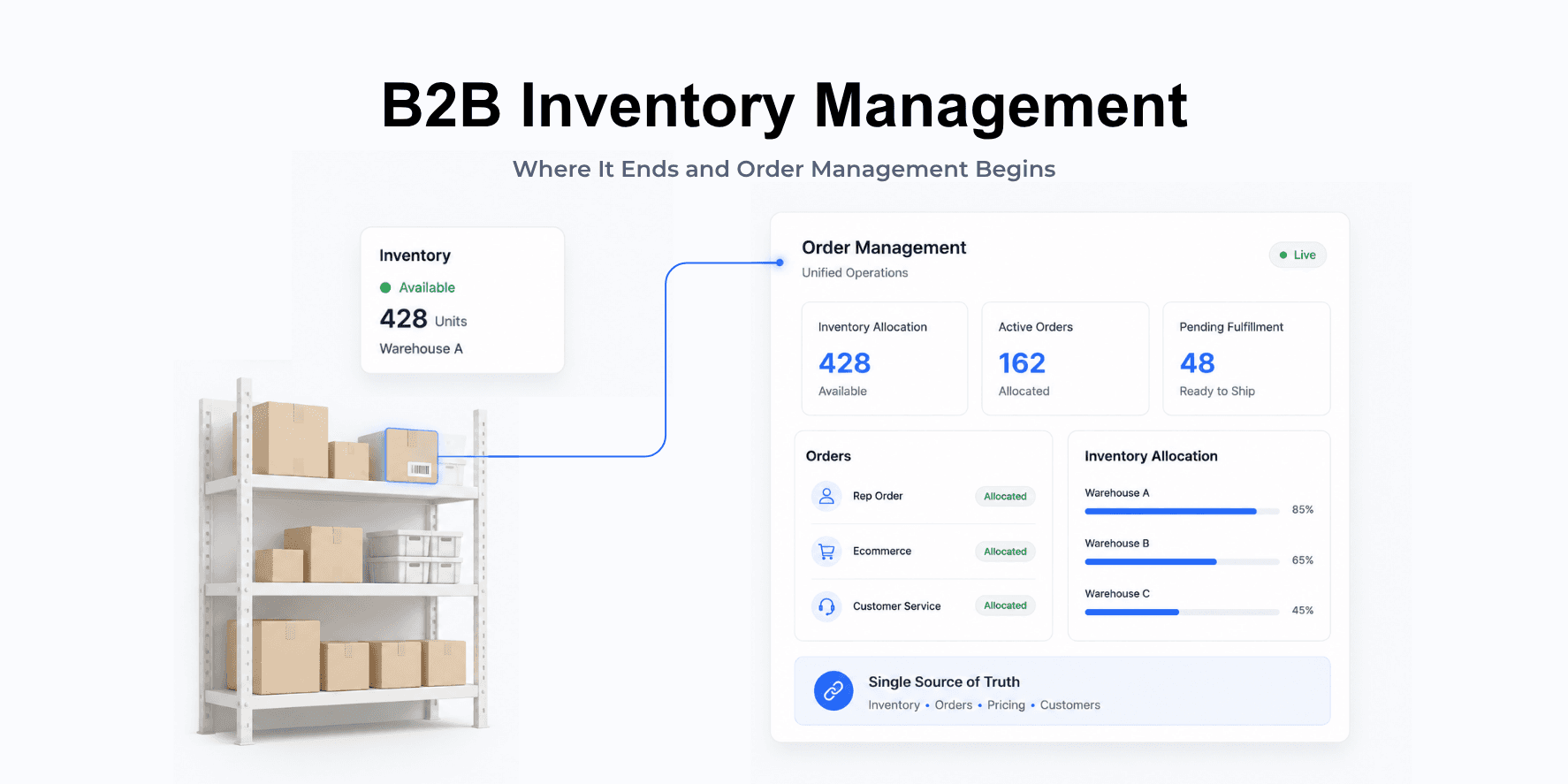
Most B2B companies do not lose money because they run out of stock. They lose money because different systems disagree about how much stock they have. The warehouse shows 400 units, the ecommerce store shows 350, and a field rep just promised 500 to their biggest customer.
B2B inventory management is the practice of tracking, controlling, and replenishing the stock a business sells to other businesses. It covers everything from purchase orders and warehouse counts to demand forecasting and reorder planning. In a multi-channel B2B operation, it is only half of the picture. This guide explains how B2B inventory management works, why it is more complex than B2C, and where inventory management ends and order management begins.
TL;DR: B2B inventory management tracks and replenishes inventory sold to business customers, with added complexity from bulk orders, contract pricing, and multiple sales channels. Inventory systems answer one question: what you have. They do not control how reps, ecommerce, and customer service allocate that inventory to customers. That is the job of a centralized order management platform, which keeps inventory, pricing, and customer data aligned across every channel. |
|---|
INDEX
What Is B2B Inventory Management?
Why B2B Inventory Is Harder Than B2C
The 4 Types of Inventory Management
Common B2B Inventory Challenges
Where Inventory Management Ends and Order Management Begins
How to Choose: IMS, ERP, or OMS
What Is B2B Inventory Management?
B2B inventory management is the process of tracking stock levels, locations, and movements for products sold to other businesses rather than individual consumers. It includes receiving goods from suppliers, storing them across one or more warehouses, monitoring quantities in real time, and triggering replenishment before stock runs out.
The core activities look familiar to anyone who has managed retail inventory. A B2B operation still counts units, sets reorder points, and reconciles physical stock against system records. The difference lies in who is buying and how. Business customers order in bulk, negotiate their own pricing, expect net payment terms, and often reorder the same products on a predictable cycle.
That buyer profile changes the stakes. A B2C stockout might cost you a $40 sale to a shopper who moves on in seconds. A B2B stockout can breach a supply agreement, stall a customer's production line, and put a six-figure annual relationship at risk. Accuracy matters more, and so does the connection between inventory data and the systems your customers and reps actually use to place orders, a topic covered in depth in our guide to B2B order fulfillment.
Why B2B Inventory Is Harder Than B2C
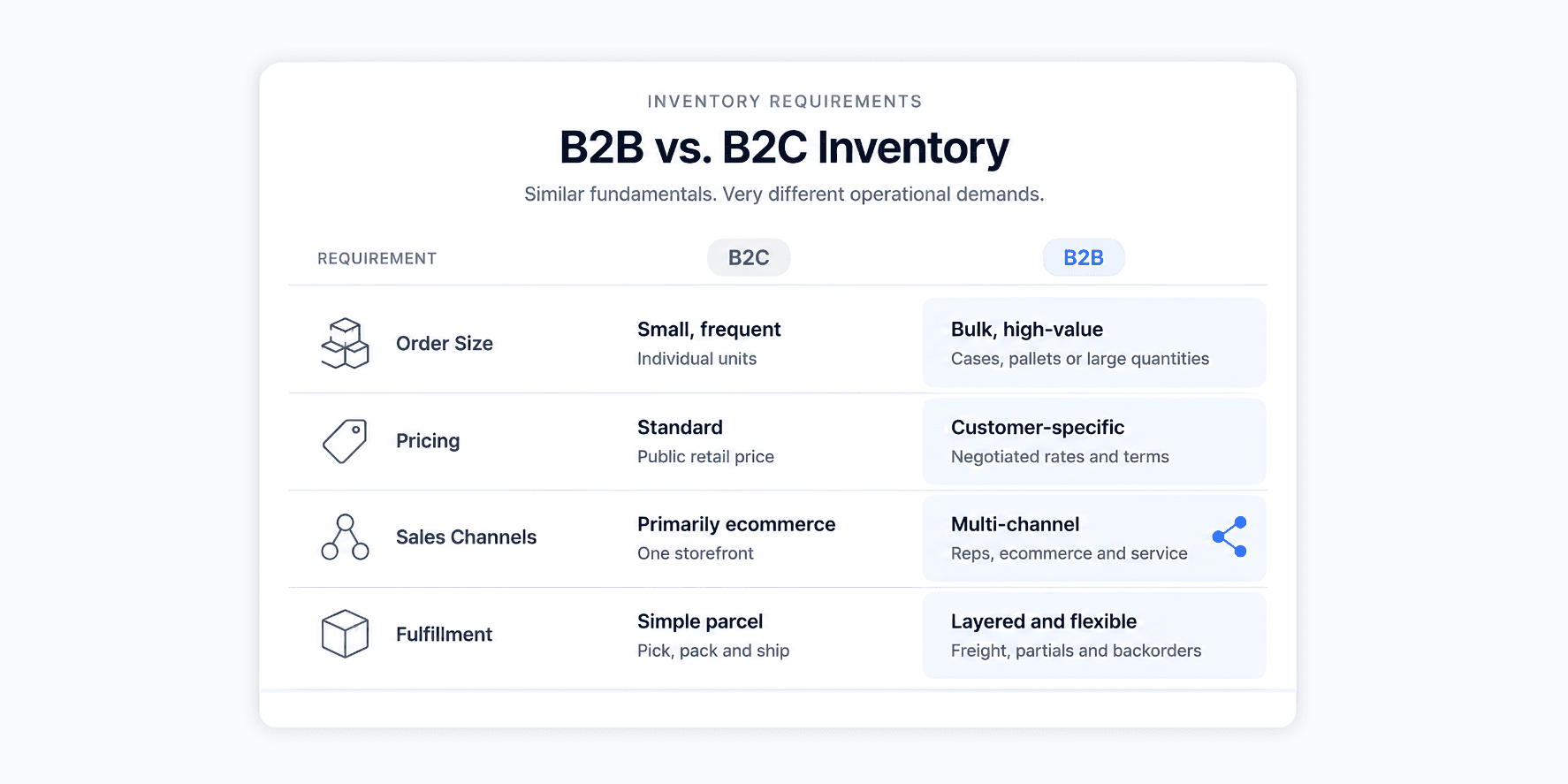
The structural differences between B2B and B2C selling make inventory management significantly more complex. Four factors drive that complexity.
Order size and frequency. B2C companies process thousands of small orders. B2B companies process fewer orders at far higher volumes, so a single mispicked or oversold order carries much more weight. Forecasting also works differently: demand follows contract cycles and seasonal purchasing patterns rather than individual buying behavior.
Customer-specific terms. Business customers buy on negotiated price lists, tiered discounts, and credit limits. Inventory allocation has to respect those agreements. If two customers want the same remaining pallet, the system needs to know who has a contractual claim to it.
Multiple sales channels. A typical mid-market B2B seller takes orders through field reps, an ecommerce portal, customer service by phone and email, and trade shows. Each channel needs an accurate view of available stock at the time of sale, not after a nightly sync.
Longer, layered fulfillment. B2B shipments involve freight, partial deliveries, backorders, and staged releases. Inventory has to be committed, reserved, and allocated in ways a simple in-stock/out-of-stock flag cannot represent.
The 4 Types of Inventory Management
Most inventory strategies fall into four established methods, and B2B most B2B operations use a combination of them.
Just-in-Time (JIT). Stock arrives shortly before it is needed, minimizing carrying costs. JIT rewards suppliers with reliable lead times and punishes everyone else, so B2B distributors tend to apply it only to fast-moving, easily sourced SKUs.
Materials Requirement Planning (MRP). Inventory needs are calculated backward from sales forecasts and production schedules. Manufacturers selling B2B rely on MRP to make sure raw materials arrive in step with committed customer orders.
Economic Order Quantity (EOQ). A formula-driven approach that calculates the ideal order size to minimize the combined cost of ordering and holding stock. EOQ works well for products with stable, predictable B2B demand.
Days Sales of Inventory (DSI). More a discipline than a method: tracking how many days your current stock would last at the current sales rate, then managing purchasing to keep that number inside a healthy range.
Regardless of the method, the input is the same. Every approach depends on accurate, current data about what is selling, through which channel, and to which customer. When that data lives in disconnected systems, even the best-designed inventory strategy relies on outdated information, a pattern we break down in the top challenges B2B businesses face in sales and operations.
Common B2B Inventory Challenges
The most damaging inventory problems in B2B rarely start in the warehouse. They start in the gap between the warehouse and the channels taking orders against it.
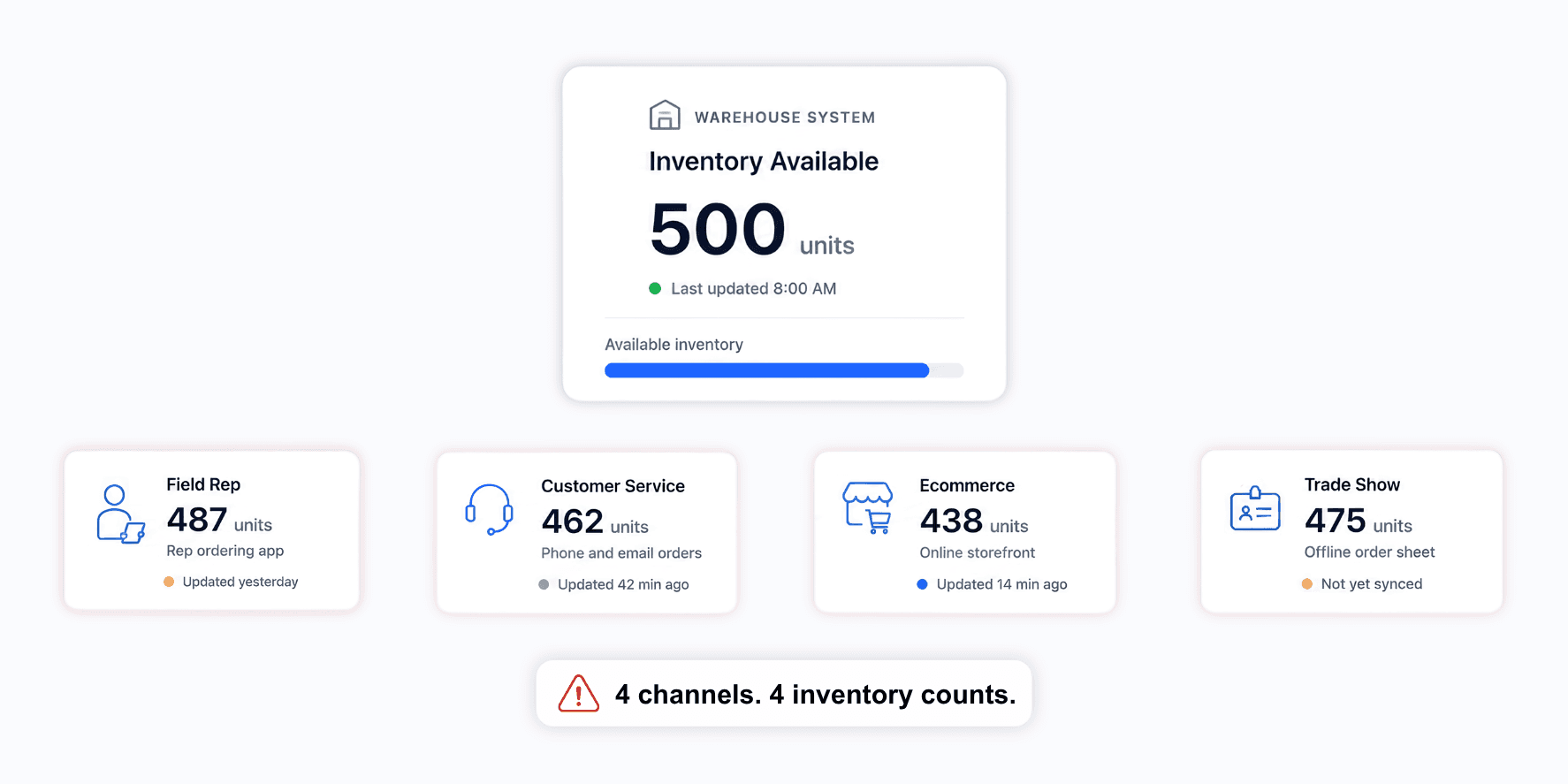
Overselling across channels. When reps, the online store, and customer service each work from their own view of inventory, multiple channels can commit the same units. The result is a backorder conversation with a customer who was told the product was available.
Manual reconciliation. Teams export inventory counts from the warehouse system, paste them into spreadsheets, and email them to reps. By the time the spreadsheet is opened, it is already outdated. Hours of admin effort go into producing numbers nobody fully trusts.
Invisible commitments. A quote sitting in a rep's inbox, a draft cart in the customer portal, and a phone order jotted on paper all represent claimed stock the inventory system knows nothing about until the order is finally entered.
Reporting blind spots. Finance wants inventory valued by channel and customer segment. Sales ops wants sell-through by rep and territory. When order data is scattered, such as across email threads and channel-specific tools, those reports take days to assemble and arrive full of asterisks. Our article on taming B2B chaos looks at how scattered systems create exactly this pattern.
None of these problems is solved by counting stock more carefully. They are order problems wearing an inventory costume.
Where Inventory Management Ends and Order Management Begins
Inventory management tells you what you have. Order management controls how every sales channel commits it to customers. Understanding that boundary is the single most important distinction a multi-channel B2B seller can make.
An inventory management system (IMS) or warehouse system serves as the source of truth for physical inventory: quantities, locations, receipts, and adjustments. It is very good at answering the question "how many units exist right now."
It is not designed to answer the questions that come next. Which rep is about to promise those units to which customer, at which negotiated price. Whether the ecommerce portal should still show the product as available after a bulk order landed five minutes ago. How a phone order, a rep order, and a portal reorder for the same customer roll up into one clean record for invoicing and reporting.
Those are order management questions, and they are where a single source of truth earns the most value. A centralized order management platform connects every sales channel, so pricing, commissions, inventory, and customer data stay aligned no matter where the order originates.
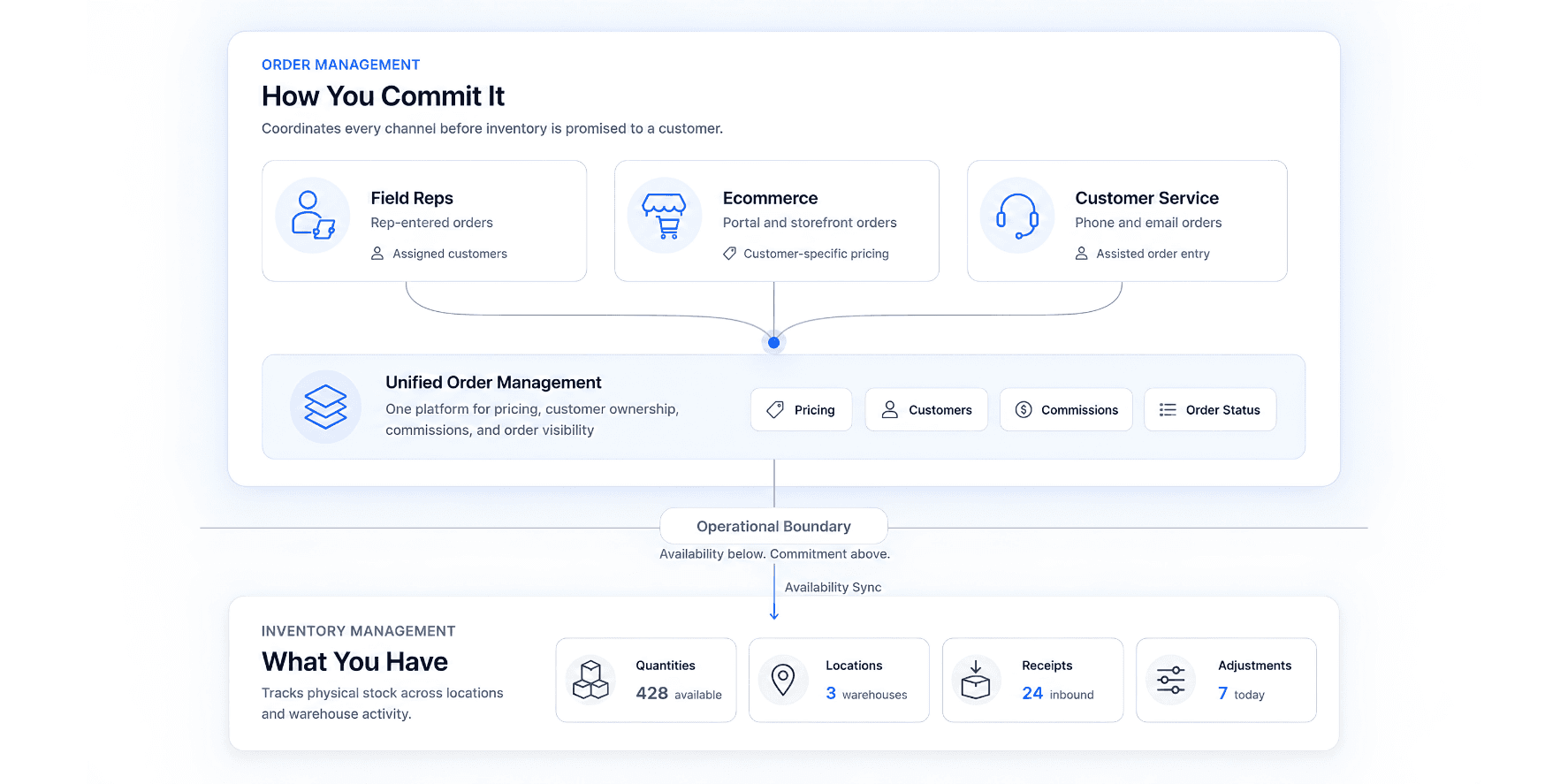
This is where Velocity Commerce operates. Velocity is not a warehouse system, and it does not try to be. It unifies the orders placed by field reps, ecommerce, and customer service into one platform, so the inventory tracked by your IMS is committed consistently instead of being sold twice. Reps see accurate availability for their own customers, buyers reorder through a self-service portal with their negotiated pricing, and operations gets order, shipping, customer, and commission reporting from one place. For Shopify-based B2B sellers, the same alignment extends into the storefront through Velocity's native integration, which we cover in our Shopify order management guide.
The payoff is simple: fewer oversells, cleaner order-to-cash data, and sales channels that finally stay in sync.
How to Choose: IMS, ERP, or OMS
The right system depends on the problem your business is trying to solve. Use the distinction from the previous section as your decision framework.
Choosing an IMS or WMS when managing physical inventory is the problem. If counts are inaccurate, warehouse picking is slow, or replenishment is guesswork, you need stronger inventory management before anything else. No order platform can fix a warehouse that doesn’t know what’s on its shelves.
Consider an ERP when finance and operations need a single system of record across the business. ERPs bundle inventory, accounting, and purchasing. The trade-off is that their selling tools are usually limited, leaving rep-led teams to bolt spreadsheets back on top.
Choose an OMS when your inventory counts are accurate but your sales channels disagree. If the warehouse data is reliable and the pain shows up as oversells, manual re-keying, rep confusion, or reporting that never reconciles, the gap is in order management. An OMS such as Velocity connects to your existing stock data and commerce stack instead of replacing them, making it the lighter-weight solution for multi-channel sellers.
Many B2B companies run two of these together. A common pattern pairs an IMS or ERP holding the stock ledger with an OMS unifying how reps and customers order against it. The mistake is buying another inventory tool when inventory was never the real problem.
Final Thoughts
Strong B2B inventory management is essential, but it isn’t enough on its own. Accurate counts, sensible reorder points, and methods like EOQ or MRP keep the warehouse running efficiently. But the failures that cost B2B companies their customers usually happen after the count, when disconnected channels commit the same stock twice or bury orders in email threads.
Drawing the line between inventory management and order management clarifies the fix. Keep your stock ledger where it works today, and unify how every sales channel commits inventory against it. The result is greater accuracy, faster order-to-cash, and a consistent customer experience across every channel.
If your inventory counts are solid but your reps, ecommerce store, and customer service still disagree about what is available, book a demo with Velocity Commerce to see how a unified order management platform closes that gap.
FAQs
What is the 80/20 rule for inventory?
The 80/20 rule, also called Pareto analysis or ABC analysis, holds that roughly 80% of a company's sales value comes from about 20% of its SKUs. In practice, B2B teams use it to prioritize: the top-selling 20% of products get tighter counts, safety stock, and faster replenishment, while slow movers are reviewed less often and stocked more conservatively.
What are the 4 types of inventory management?
The four most widely used inventory management methods are Just-in-Time (JIT), Materials Requirement Planning (MRP), Economic Order Quantity (EOQ), and Days Sales of Inventory (DSI). JIT minimizes carrying costs by receiving stock close to when it is needed, MRP plans inventory from forecasts and production schedules, EOQ calculates the most cost-efficient order size, and DSI measures how long current stock will last at the current sales rate.
What are the 4 types of B2B markets?
The four classic B2B market types are producers (businesses that buy inputs to make other products), resellers (wholesalers and distributors that buy finished goods to sell on), governments (public agencies purchasing at every level), and institutions (organizations such as hospitals, schools, and nonprofits). Each segment buys differently, which is one reason B2B inventory and order workflows need customer-specific pricing and terms.