Vendor Financing: How Manufacturers Offer Equipment Financing Without Becoming the Lender


Most explanations of vendor financing are written from the lender’s side of the table. Bank guides describe it as a product offered to businesses, while acquisition guides describe it as a way to buy a company from its current owner. Both are accurate, but neither addresses the decisions a manufacturer has to make before offering financing on its own equipment.
Those decisions shape how the program operates. The program model determines who funds each purchase, who holds the contract, who carries the credit risk if a customer stops paying, and what financing costs the seller. Manufacturers that choose the right vendor financing structure can offer payment options on five- and six-figure equipment without lending their own capital.
This guide explains how vendor financing works, the program models available to equipment sellers, and what each model means for risk and cost.
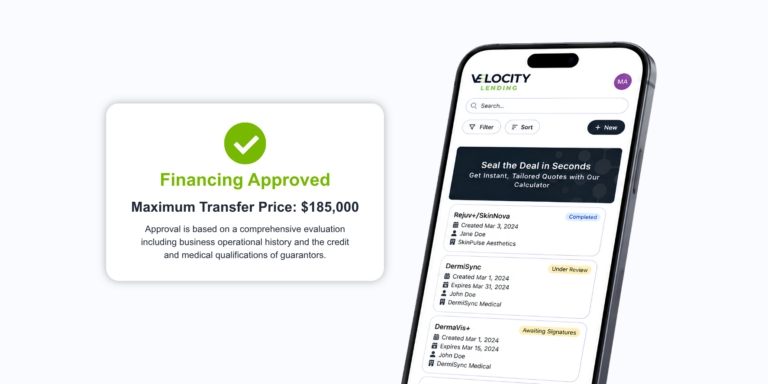
| TL;DR: Vendor financing is credit that a seller extends or arranges so a customer can buy its products and pay over time. Manufacturers can run it in-house, through a captive finance company, or through a third-party vendor finance program, and that choice determines who funds the purchase and how credit risk is structured. In-house programs use the seller’s capital, while third-party programs use capital from an outside finance provider. Velocity Lending validates a customer’s credit instantly, considers product transfer price, and then determines availability of financing from multiple sources. Through the platform, reps can offer customers financing directly at the point of sale, with decisions available in under 30 seconds. |
What Is Vendor Financing
Vendor financing is a form of credit in which the seller lends directly to the customer or arranges financing through a partner, allowing the customer to purchase the product and pay for it over time. The term is also referred to as vendor finance. In equipment sales, the credit usually takes the form of a loan, a lease, or an installment agreement tied to a specific purchase.
In a vendor equipment financing program, financing is presented as part of the sale rather than arranged separately by the customer. The customer receives the equipment and makes payments over an agreed term. The seller can close the sale without waiting for the customer to secure outside capital.
Vendor financing can take two forms. Debt vendor financing is the more common form, where the customer repays the amount financed plus interest or fees over a set term. Equity vendor financing, where the seller accepts shares in the buyer’s business instead of cash, is more common in early-stage technology deals and business acquisitions. This guide focuses on debt vendor financing for equipment purchases.
Vendor financing vs trade credit
Trade credit and vendor financing both let a customer pay later, but they apply to different kinds of purchases. Trade credit usually covers recurring orders of inventory or supplies on short terms such as net 30 or net 60, typically with no financing charge when the invoice is paid on time. We cover how those payment terms fit into B2B ordering in our guide to B2B checkout.
Vendor financing typically covers larger capital purchases. Terms run for years rather than weeks, with financing costs built into the payment.
How Vendor Financing Works
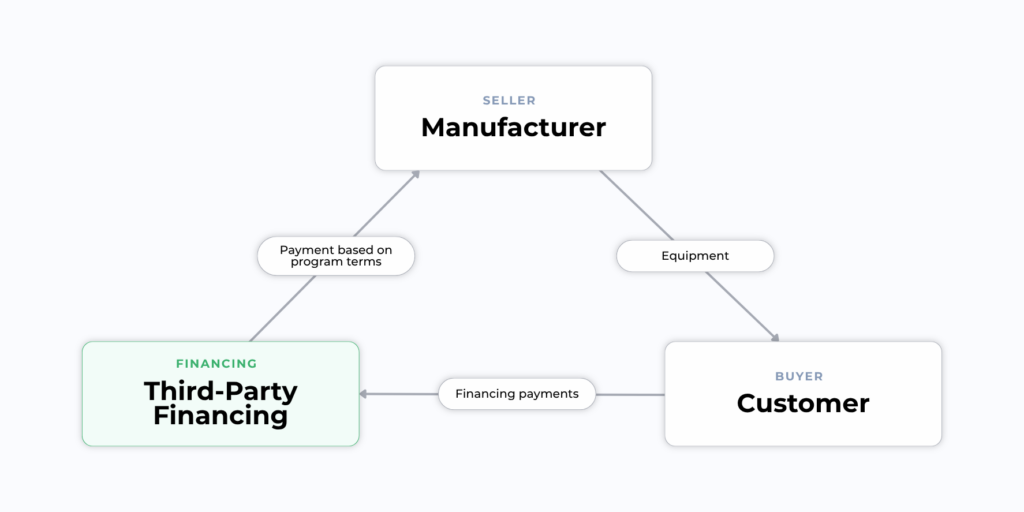
Most vendor financing arrangements involve three roles: the seller, the customer, and the party funding the purchase. In some programs, the seller fills two of those roles at once.
The process is similar across programs. The seller quotes the equipment and presents a monthly payment alongside the total price. The customer applies, and either the seller’s credit team or finance provider makes the credit decision, depending on the program. Once the agreement is signed, the equipment ships and the customer makes payments over the agreed term.
Programs differ in how payments are handled and when the seller is paid. When the seller funds the purchase, it ships the equipment and collects customer payments over the full term. When a third party funds the purchase, the seller receives payment according to the program terms, while the customer makes payments under the financing agreement.
Application speed and document requirements also vary by program. Traditional equipment financing can take several days and require financial documents such as bank statements or tax returns, while automated financing platforms can return decisions in minutes. We cover how financing can move through the sales process, from payment estimate to signed contract, in our guide to point of sale financing.
Types of Vendor Financing Programs
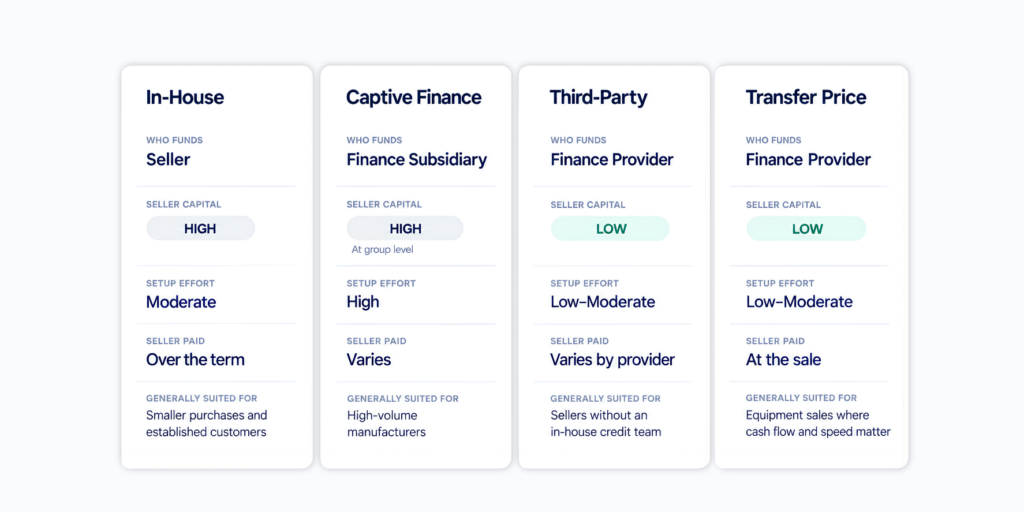
Manufacturers typically choose among three vendor financing program models, with the main difference being whose capital funds the purchase. A fourth structure, the transfer price model, is a variation of third-party financing that changes how the seller is paid.
In-house vendor financing
In an in-house program, the seller extends credit directly from its own balance sheet. The seller sets the terms, approves the customer, invoices on a schedule, and handles collections. This model gives the seller full control over pricing and approval decisions.
That control comes with additional requirements. The seller needs working capital to fund financed sales and resources to assess credit and collect payments. In-house financing tends to suit sellers with modest purchase sizes, long-standing customer relationships, or strong cash reserves.
Captive finance company
A captive finance company is a subsidiary a manufacturer creates to finance purchases of its own products. Large equipment and vehicle manufacturers commonly operate captives, allowing them to offer promotional rates and keep the customer relationship within the corporate group.
Scale is the tradeoff. Setting up a captive requires capital, licensing, underwriting resources, and servicing operations, so this model generally makes sense for manufacturers with high and steady financing volume.
Third-party vendor finance program
In a third-party vendor finance program, an outside finance provider funds and holds the contracts, while the seller presents the financing during the sale. Vendor financing providers include banks, independent finance companies, and financing platforms. The seller gains a financing option without committing its own capital, while the provider gains a steady flow of applications from the seller’s sales channel.
Program terms, approval criteria, and funding speed vary by provider. Some programs are branded as the manufacturer’s own financing, often called private label programs, while others are presented under the provider’s name.
Transfer price model
In a transfer price model, the product is purchased from the seller at an agreed price and financed for the customer. The seller receives the agreed amount for the equipment, while the customer repays the financing according to the terms of the agreement.
Who Carries the Risk: Recourse and Non-Recourse Programs
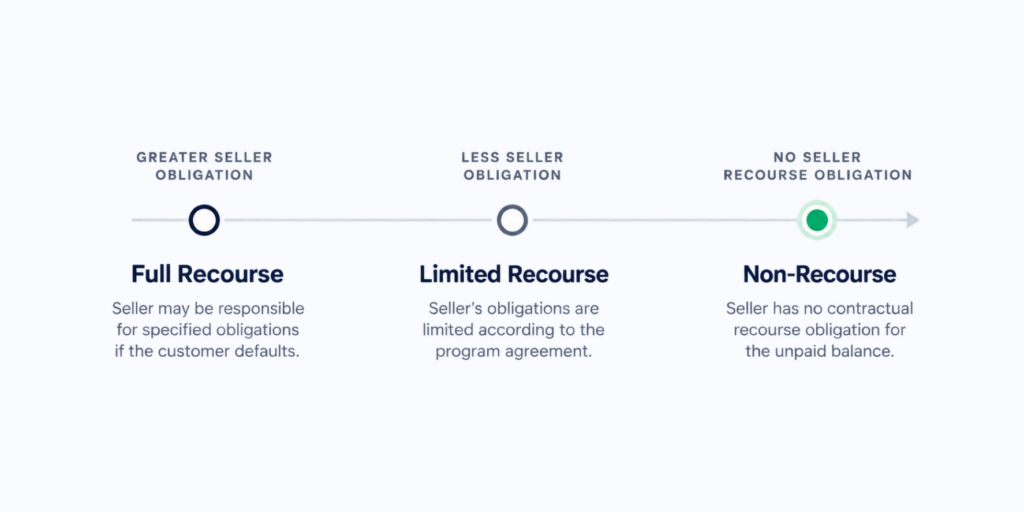
Recourse terms determine the seller’s obligations if a financed customer stops paying, and they vary across vendor financing programs. Two programs can look identical to the customer while leaving the seller with very different obligations.
- Full recourse. The seller agrees to repurchase the contract or cover the unpaid balance if the customer defaults. A finance provider funds the sale, but some or all of the default risk remains with the seller.
- Limited recourse. The seller’s obligation is capped, for example at a share of the balance, a set number of payments, or a commitment to remarket repossessed equipment.
- Non-recourse. If the customer defaults, the seller is not contractually responsible for the unpaid balance.
Pricing and approval criteria can also vary with recourse terms. Different recourse structures may affect customer rates, approval criteria, and other program terms.
Sellers comparing programs should request recourse, repurchase, and remarketing obligations in writing. Those terms can affect the seller’s balance sheet for the full length of every financed contract.
What Vendor Financing Costs
Vendor financing costs can affect both sides of the transaction: what the customer pays and any costs the seller incurs to offer financing..
Cost to the customer
Customer rates for vendor financing can depend on the customer’s credit profile, financing term, purchase size, and the program’s funding source. Rates are often comparable to bank equipment financing, though programs that approve a broader range of businesses may price in that additional risk. Manufacturers sometimes subsidize rates to support sales or offer promotional financing for a limited term. Requirements vary by provider, so the rate on a specific deal depends on the program and the applicant.
Some programs present the cost as a single monthly payment rather than a separate rate and fee schedule. This can make it easier for a customer to compare the payment with the revenue the equipment is expected to generate.
Cost to the seller
The seller’s cost depends on the program model. In-house programs tie up capital in receivables and require resources to assess credit and collect payments. Any defaults can also reduce the margin on the original sale.
Third-party programs may charge the seller a discount fee on each financed sale or ask the manufacturer to fund a rate subsidy.
Benefits and Drawbacks of Vendor Financing
Vendor financing can help sellers close larger purchases while helping buyers preserve cash, though the tradeoffs depend heavily on the program model.
| Benefits | Drawbacks | |
|---|---|---|
| For the seller | Can shorten sales cycles by removing the buyer’s capital budget as an immediate obstacle. Can support larger configurations once the conversation shifts to a monthly payment. Gives reps a consistent way to present financing during the sales process. | In-house and full recourse programs can leave the seller responsible for customer default risk. In-house and captive models require capital and operational resources. Approval criteria set by a finance provider are outside the seller’s control. |
| For the buyer | Can preserve cash and bank credit lines for other uses. Spreads the cost across the period the equipment generates revenue. Financing is arranged during the purchase rather than through a separate lender. | Total cost over the term is higher than paying in full. Rates may be higher than a bank loan for some borrowers. Early payoff terms vary by provider. |
The program model determines many of the tradeoffs on the seller side. A third-party program can eliminate the need for the seller to fund customer purchases, while recourse terms determine the seller’s obligations if a customer defaults. Buyer-side tradeoffs depend more on the specific provider’s rates, terms, and prepayment policy.
Vendor Financing Outside Equipment Sales
The term vendor financing also appears in business acquisitions, where an owner finances part of the purchase price for the buyer. In that context, the arrangement is usually called a vendor loan, a vendor take-back, or a seller note.
Buyers typically pay part of the price at closing, often with a bank loan, and repay the remaining balance to the former owner over several years with interest. Vendor loans are commonly subordinated to bank debt, so the bank is typically repaid first if the business can’t meet its obligations.
Technology suppliers use a related structure when they finance or invest in customers that buy their products, a pattern that has drawn attention in the AI infrastructure market. The mechanics differ from equipment vendor financing, but the underlying purpose is the same: the seller helps fund the purchase so the sale can happen sooner.
How Velocity Lending Structures Vendor Financing
Velocity Lending brings third-party vendor financing directly into the sales process using a transfer price model. With Velocity Lending, the equipment is purchased from the manufacturer at an agreed transfer price set within a range configured in advance for each product. The manufacturer receives the agreed transfer price for the equipment. Velocity Lending then works with multiple financing partners to support financing options through the platform.
The financing workflow runs directly from the rep’s phone rather than through a separate, manual credit process. Velocity Lending performs a soft credit check on each guarantor, so applying doesn’t affect anyone’s credit score. Automated underwriting can return financing decisions in under 30 seconds. Most applications can also be processed without bank statements. We walk through each step of that workflow in our guide on how to offer financing to customers.
Velocity Lending’s customer agreement also differs from a conventional loan. It uses a subscription model that combines principal and interest into one monthly payment, with terms of 24, 36, 48, or 60 months and a deferral period available before the first payment. Velocity Lending supports product costs from $10,000 to $185,000, with financing beyond $185,000 also available in many cases.
Final Thoughts
Vendor financing decisions often come down to one question: whose capital should fund the customer’s purchase. In-house programs and captive finance companies keep that capital, and the credit risk that comes with it, inside the manufacturer. Third-party programs and transfer price models move both to a finance provider, allowing the seller to offer financing without becoming the lender.
For equipment with five- and six-figure purchase sizes, the program model can affect cash flow, customer relationships, and how quickly reps can close. Recourse terms, approval speed, and the cost to both parties deserve the same attention as the rate itself.
Velocity Lending uses a transfer price model in which the manufacturer receives the agreed transfer price for the equipment, while automated underwriting can return financing decisions in under 30 seconds. To see how Velocity Lending can support your equipment sales, talk to our team.
FAQs
The seller presents financing as part of the sale, the customer applies, and either the seller or a finance provider makes the credit decision. Once the agreement is signed, the equipment ships and the customer repays over an agreed term. When a third party funds the purchase, the seller receives payment according to the program terms rather than funding the customer’s purchase from its own balance sheet.
There is no single typical rate. Vendor finance rates depend on the customer’s credit profile, financing term, purchase size, and the program’s funding source. Requirements and rates vary by provider, and some manufacturers may subsidize rates to support sales. Some programs quote a single monthly payment instead of a separate rate.
A vendor loan is financing that the seller of a business provides to the buyer to cover part of the purchase price. The buyer pays the rest at closing, often with a bank loan, and repays the vendor loan to the former owner over several years with interest. Vendor loans are commonly subordinated to bank debt, so the bank is typically repaid first.
A vendor financing program is a structured arrangement through which a seller offers financing on its products, funded by its own balance sheet, a captive finance company, or a third-party finance provider. The program sets approval criteria, financing terms, purchase ranges, funding structure, and recourse obligations.
Equipment leasing is one of the forms vendor financing can take. In a lease, the lessor owns the equipment and the customer pays to use it, with end-of-term options set by the lease type. Vendor financing describes financing offered or arranged as part of the seller’s sales process and can be structured as a loan, a lease, or an installment agreement.
See how Velocity fits your B2B team.
Schedule a demo