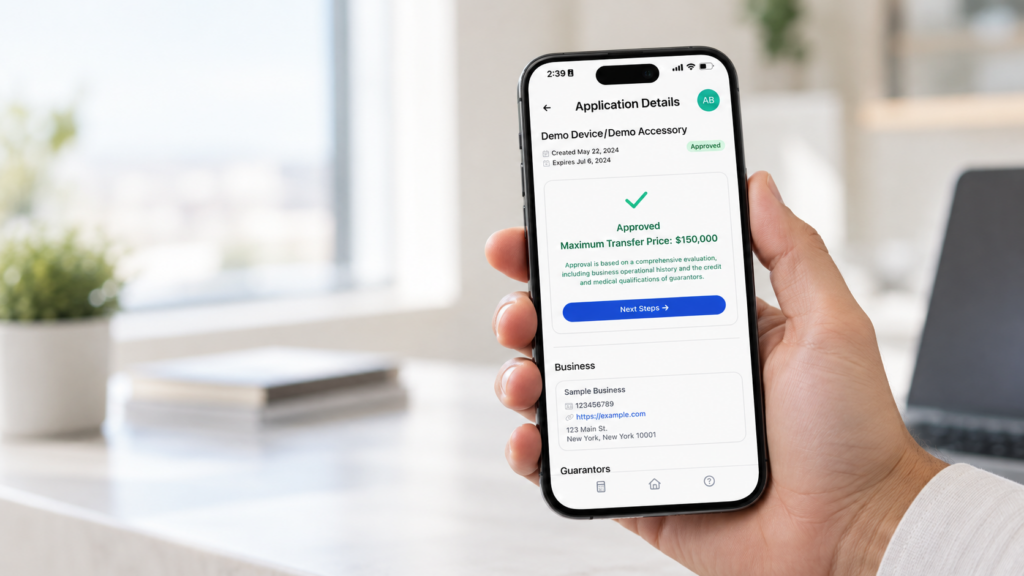
Embedded lending integrates financing into the purchase process, allowing customers to apply and receive financing decisions during the sales conversation.
Most embedded lending guides focus on software platforms that offer loans to small merchants or consumers.
This guide explains how embedded lending works for high-value equipment sold by field sales reps, how it compares to traditional equipment financing, and what manufacturers should look for in a platform.
| TL;DR: Embedded lending integrates financing into the sales process, allowing customers to apply, receive a decision, and sign contracts during the sale. For equipment and device manufacturers, it can shorten sales cycles, support larger purchases, and streamline financing across sales teams. Velocity Lending brings embedded lending into the field with automated decisions in under 30 seconds and access to multiple financing partners. |
What Is Embedded Lending?
Embedded lending, also called embedded financing, integrates credit directly into a non-financial company’s product or sales process. Instead of sending the customer to a bank to apply separately, sellers offer financing directly within online checkout, business software, or a sales meeting. A lending partner, or a network of them, evaluates applications and provides financing, while the seller or platform manages the application experience.
Embedded lending is one component of embedded finance, alongside services such as embedded payments, insurance, and banking. Lending typically involves additional requirements, including credit decisions, financing agreements, and payment schedules.
In consumer markets, embedded lending usually appears as buy now, pay later at an online checkout. B2B software platforms often offer working capital financing based on a merchant’s transaction history. For equipment and device manufacturers, embedded lending brings financing into the sales conversation, so the customer can apply while evaluating the equipment with their sales rep.
How Embedded Lending Works
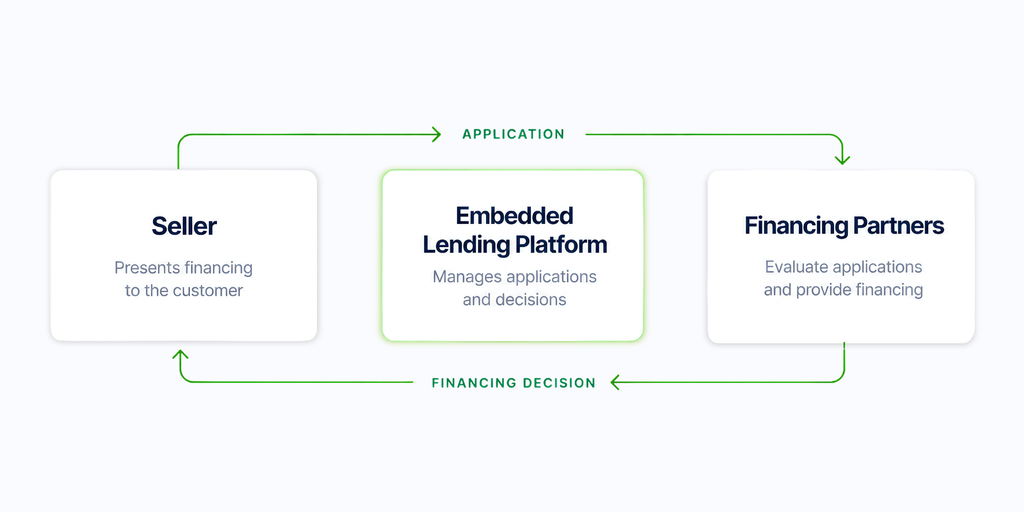
Every embedded lending program connects three parties, each with a distinct role:
- The seller (a manufacturer, OEM, or distributor) manages the customer relationship and presents financing during the sale.
- The platform manages estimates, applications, financing decisions, and contracts, while connecting sellers with financing sources.
- Lending partners, such as banks, brokers, and other financing providers, establish credit criteria, evaluate applications, and fund the contracts.
This structure allows manufacturers to offer financing without managing lending operations in-house. How credit risk is structured depends on the program terms, and we cover recourse, the seller’s obligations, and other program structures in our guide to vendor financing.
The embedded lending process in an equipment sale
Steps vary by provider, but a typical embedded equipment financing workflow follows this process:
- Estimate. The rep generates a payment estimate based on the equipment price, down payment, and term.
- Application. The rep enters business information, guarantors, and the products being financed.
- Credit decision. Automated underwriting evaluates the application and returns a status such as approved, pre-approved, under review, or denied.
- Pricing and terms. The transfer price is confirmed, and the customer selects a term length.
- Contract. The financing agreement is sent to the customer for e-signature.
- Funding. After post-sale requirements are completed, the seller receives payment according to the program terms, while the customer makes payments under the financing agreement.
Speed depends on how much of the financing process happens within one system. When estimates, applications, and contracts require separate tools, each handoff can add hours or days to the sale. Our point of sale financing guide explains why receiving decisions during the customer meeting matters.
Embedded Lending vs. Traditional Equipment Financing
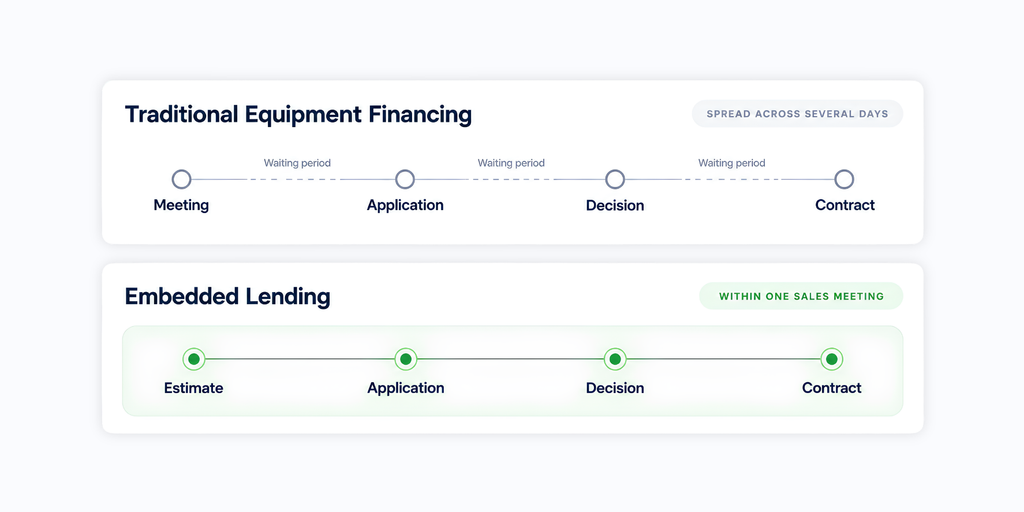
Traditional equipment financing typically separates the purchase and financing decisions. After the sales meeting, the customer applies through a bank or financing provider, and the deal waits for a decision. Embedded lending integrates financing directly into the sales process.
| Lender referral | Captive or in-house financing | Embedded lending platform | |
|---|---|---|---|
| Where the customer applies | Lender’s application, separate from the sale | Seller’s finance team or captive program | Inside the seller’s sales process |
| When the customer receives a decision | Often days later, depending on the lender | Varies with internal review capacity | Can be during the sale with automated underwriting |
| Financing sources | Usually one lender per referral | The seller or its captive finance program | Can include multiple financing partners |
| Seller resources required | Low, with limited visibility into deal status | Can require dedicated credit, collections, and compliance resources | Generally low, since the platform manages the workflow |
| How the seller is paid | According to the lender’s terms | According to the program structure | According to the program terms |
Embedded lending changes where financing happens. With a referral, customers typically pursue financing separately. With an embedded platform, reps can present payment options, submit the application, and review the decision during the sales meeting. Among the three options in this article, embedded lending generally requires the fewest internal resources while keeping financing inside the sale.
Embedded Lending Examples in B2B
Embedded lending varies based on the purchase and sales process. Common B2B embedded lending examples include:
- Working capital through business software. Payments and accounting platforms offer merchants short-term financing based on transaction history.
- Net terms at checkout. B2B ecommerce platforms can offer payment terms to approved buyers, with a third party evaluating the buyer’s credit. Our B2B checkout guide explains how payment terms and purchase orders fit into the ordering process.
- Buy now, pay later for business purchases. Installment payments at checkout help buyers spread the cost of supplies and smaller inventory orders.
- Equipment financing at the point of sale. Field reps present financing during the sales conversation for high-value equipment and devices.
- Lending marketplaces. Platforms connect lenders with financing applications that match their credit criteria.
Equipment financing often involves larger purchases and a more complex sales process. Checkout installment plans typically cover smaller orders, while equipment purchases often range from $10,000 to several hundred thousand dollars. Larger purchases may require guarantor information, a more detailed credit review, and a signed financing agreement, so the embedded workflow must support more than a single click at checkout.
Why Equipment Manufacturers Use Embedded Lending
For manufacturers and OEMs selling high-value equipment, embedded lending can streamline . Four key benefits include:
Shorter sales cycles
Financing decisions received during the customer meeting can eliminate lengthy waiting periods. With an approval in hand, reps can move directly towards contracts and delivery rather than additional financing follow-ups.
Support for larger purchases
Monthly payment options can help customers evaluate larger equipment purchases while preserving cash for other business needs. Reps can recommend equipment that meets customer needs and demonstrate monthly payment options without immediately reducing the order to fit an upfront budget.
A consistent financing offer across the sales team
A standardized estimate and application workflow helps reps deliver a consistent financing experience across territories. Sales leaders can track deal progress without asking reps for status updates.
Less administrative work for reps and finance teams
Automated document delivery and real-time deal tracking can reduce the manual follow-up that traditional financing often requires. Estimate your team’s potential financing cycle time savings with the Velocity Lending time savings calculator.
For manufacturers still deciding whether to offer financing at all, we cover program options, partner selection, and rollout in our playbook on how to offer financing to customers.
What to Look for in an Embedded Lending Platform
An embedded lending platform should support your existing sales process without adding unnecessary complexity. Use this checklist when you evaluate providers.
Speed and approval capacity
- Financing decisions returned during the customer meeting
- Multiple financing partners available for each application
- Credit evaluation beyond credit scores, supporting a broader range of business types
- Soft credit checks used for initial decisions
Rep workflow
- Mobile access for field reps and desktop access for office teams
- Real-time payment estimates based on price, down payment, and financing term
- Applications, contracts, and documents managed in one platform
Visibility and control
- Real-time deal tracking from application submission through funding
- Post-sale requirements, such as invoices and proof of delivery, tracked in one place
- Deal activity visible to sales leaders across territories
Security and terms
- Audited security controls in place
- Customer and guarantor information protected throughout the process
- Contract terms, including prepayment terms, presented clearly to the customer
Embedded lending providers vary in their capabilities. Some offer only an application link, while others manage the financing process from estimate through funding. Ask each provider to demonstrate the complete workflow, including what happens after approval.
How Velocity Lending Embeds Financing in the Sale
Velocity Lending brings equipment and device financing directly into the sales conversation, giving reps one mobile-first platform to generate estimates, submit applications, receive financing decisions, send contracts, and track deals.
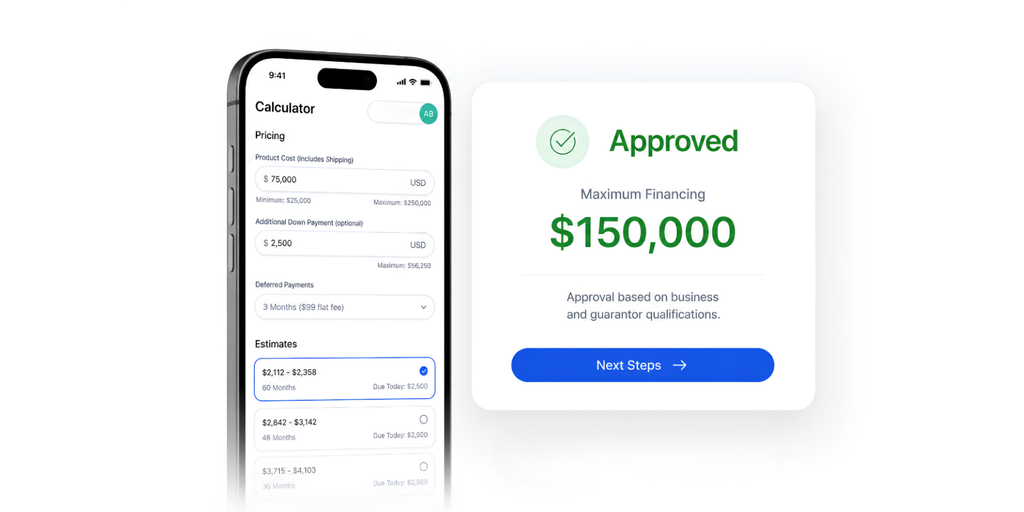
With Velocity Lending, the rep enters customer information, adds the products and guarantors, and submits the application directly from the field. Velocity Lending validates a customer’s credit instantly, considers the product transfer price, and then determines the availability of financing from multiple sources. Automated underwriting can return financing decisions in under 30 seconds. Velocity Lending performs a soft credit check, and most applications can be processed without bank statements.
Following a financing decision, the transfer price is confirmed and the customer selects a 24, 36, 48, or 60 month term. Velocity Lending’s subscription model combines principal and interest into a single, straightforward payment, and there’s no prepayment penalty. Contracts are sent for e-signature from the app, and reps can track application status, contracts, and post-sale requirements in real time.
Velocity Lending works with multiple financing partners. Through the banks and brokers side of the platform, lenders set their desired credit criteria and access deals across industries, helping support approval capacity for manufacturers. The manufacturer receives the agreed equipment transfer price, while the customer makes payments under the financing agreement.
Final Thoughts
Embedded lending integrates financing into the equipment sales conversation rather than requiring a separate process after the meeting. For manufacturers and OEMs, embedded lending can shorten sales cycles, support larger purchases, and standardize financing workflows across sales teams. The platform behind the program determines how much of the process runs inside the sale, from the first estimate to funding.
Velocity Lending equips sales teams with instant estimates, fast financing decisions, and real-time deal tracking in one mobile-first platform. To see how it can fit your sales process, talk to our team.
FAQs
Embedded lending is the practice of offering credit inside a non-financial company’s product or sales process. Customers can apply through online checkout, business software, or during a sales meeting, while a lending partner evaluates the application and funds the credit.
Embedded finance covers any financial service delivered by a company outside the financial industry, including payments, insurance, and banking. Embedded lending is a subset of embedded finance, focused specifically on credit such as loans, installment plans, and equipment financing.
Common examples include working capital offers inside payments or accounting software, net terms at a B2B ecommerce checkout, buy now, pay later for business purchases, and equipment financing presented by a sales rep at the point of sale.
Point of sale financing, also called point of sale lending, describes when financing is offered: during the purchase process. Embedded lending describes how financing is integrated into a seller’s sales process or software. Equipment financing offered through an embedded platform can qualify as both.
Lending partners such as banks, brokers, and other financing providers generally evaluate applications and fund the contracts. The seller presents the offer, and a platform connects the two. How credit risk is structured depends on the program terms, and requirements vary by provider.
Evaluate how quickly the provider can return financing decisions, how many financing partners are available, whether reps can complete the full process from a mobile device, and how application status and post-sale requirements are tracked. Ask each provider to walk through a complete deal, from estimate to funding.
See how Velocity fits your B2B team.
Schedule a demo