
Wholesale Order Management: Handle Credits, Refunds, and Returns Without Spreadsheet Chaos
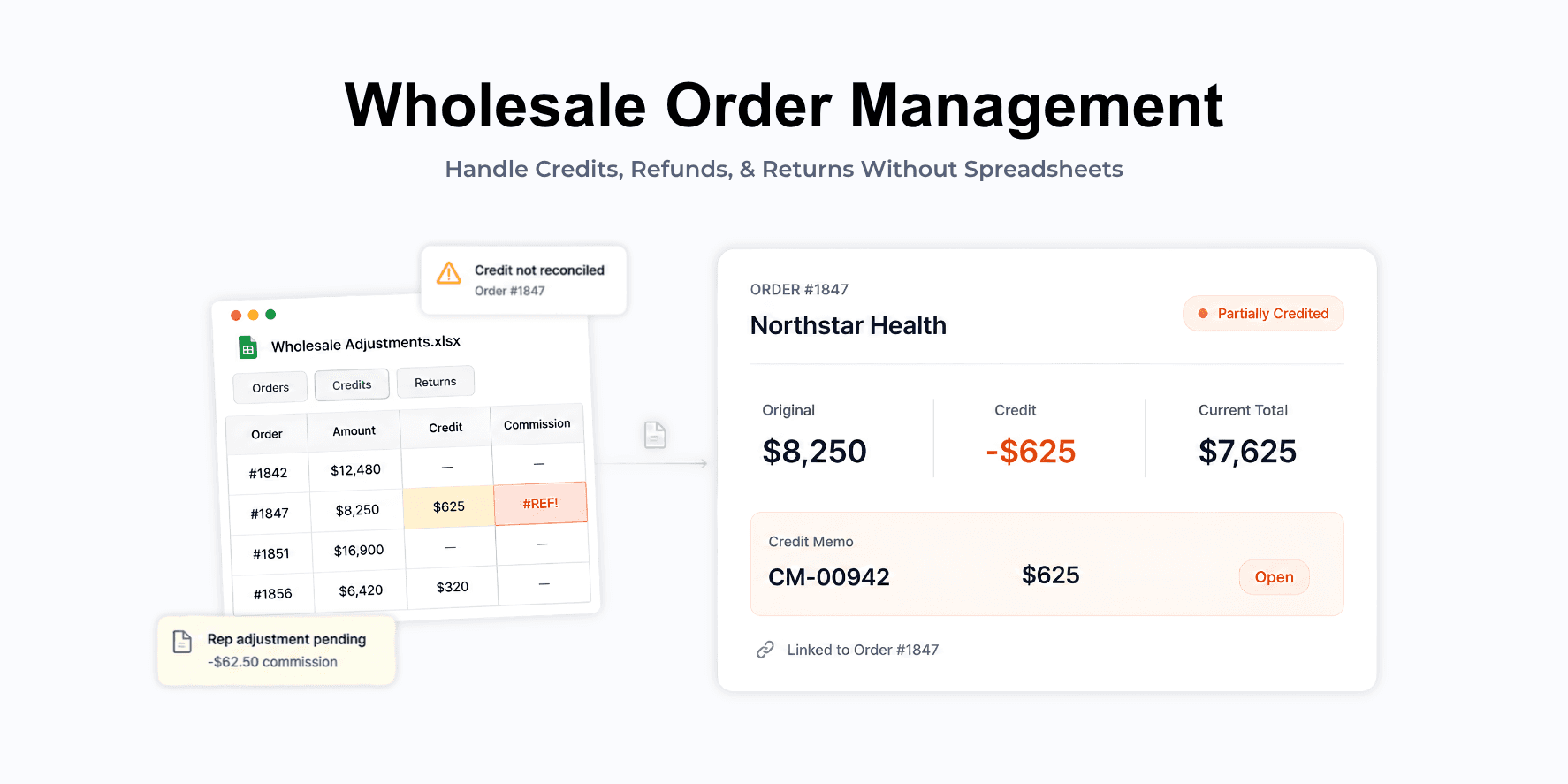
Most wholesale operations do not fall apart at the point of sale. They fall apart three weeks later, when a customer reports a short shipment, a rep promises a credit, and finance discovers that the original order, credit, and commission adjustment all live in different places.
Wholesale order management is often described as the process of capturing and fulfilling bulk orders. That definition covers only the easy half. The harder half begins after the order ships, when returns, credits, refunds, and price adjustments rewrite numbers other teams have already reported on.
TL;DR: Wholesale order management covers the full order-to-cash cycle, not just order capture and fulfillment. The stage that breaks most often is post-order adjustments: returns, credit memos, refunds, and commission reversals. When those adjustments happen in spreadsheets and emails, revenue reporting, inventory counts, and rep commissions drift apart within a single quarter. A centralized order management platform keeps each adjustment attached to the original order, keeping every downstream number accurate. |
|---|
INDEX
What Wholesale Order Management Actually Covers
The Four Stages of a Wholesale Order
Why Wholesale Orders Break Where Retail Orders Do Not
Credits, Refunds, and Returns: Where Spreadsheets Fail
How Post-Order Adjustments Corrupt Your Reporting
What to Look For in a Wholesale Order Management System
Building a Single Source of Truth Across Every Channel
What Wholesale Order Management Actually Covers
Wholesale order management is the system of record for every order a business receives from another business, from initial capture through cash collection and reconciliation. That scope is wider than most teams assume. It includes order entry from field reps, self-service portal orders, phone and email orders entered by customer service, pricing and terms validation, fulfillment handoff, invoicing, payment, and any adjustment applied afterward.
It helps to define the boundary between two neighboring systems. Inventory management answers what you have and where it sits, as covered in more detail in our guide to B2B inventory management. Fulfillment answers whether the physical goods moved, as covered in our breakdown of B2B order fulfillment reporting. Order management sits above both and captures the commercial truth of the transaction: who bought what, at what price, on what terms, and what changed afterward.
That last clause carries most of the operational weight. A wholesale order is rarely final the day it is placed.
The Four Stages of a Wholesale Order
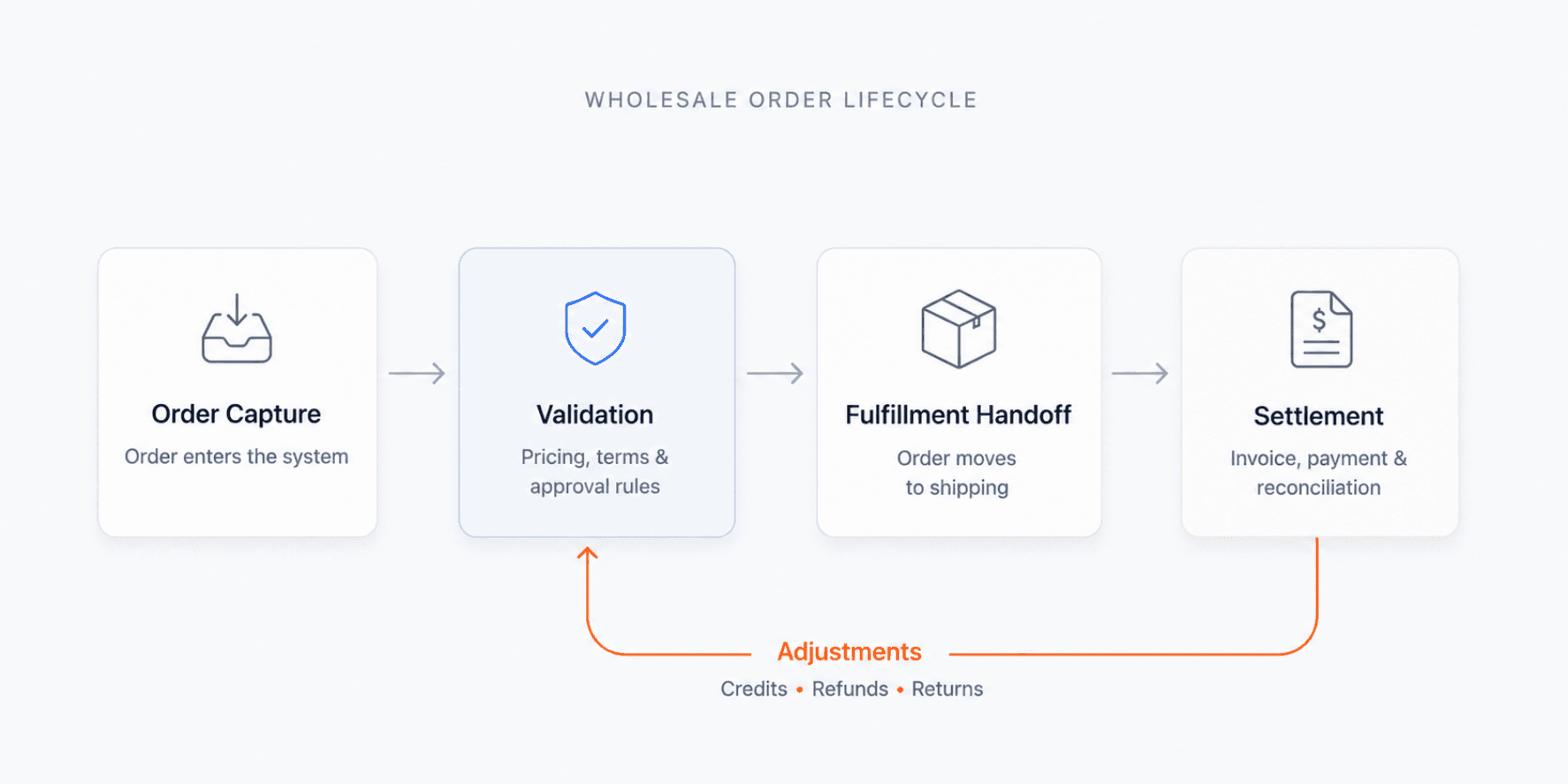
Order management is commonly divided into four stages, each producing data the next stage depends on.
Capture is where the order enters the system. In wholesale, this happens across several channels at once: a rep placing an order on a tablet at a customer site, a buyer reordering through a portal, or a customer service agent entering a purchase order received by email. Each channel needs to write to the same record structure, because a record that starts inconsistent stays inconsistent.
Validation applies the commercial rules. Tier pricing, contract pricing, minimum order quantities, credit limits, and payment terms are all validated here. The key fields on a sales order determine whether validation is automatic or requires manual review.
Fulfillment handoff sends the order to the warehouse or the third-party logistics provider and tracks what actually shipped against what was promised. Partial shipments, substitutions, and backorders all originate here.
Settlement covers invoicing, payment collection, and reconciliation. This is where credits, refunds, and short-pay disputes surface, yet it is also the stage most order management discussions skip.
Why Wholesale Orders Break Where Retail Orders Do Not
A consumer order is typically a small, self-contained event. Somebody pays, the box ships, and the transaction closes. Wholesale orders follow a different structure, and their complexities compound.
Every structural feature of a wholesale order creates another opportunity for the record to drift from reality. Net terms mean payment arrives weeks after the goods, leaving the order open long enough for something to change. Tier and contract pricing mean the same SKU can have several valid prices, and choosing the wrong one creates a credit rather than a rounding error. Purchase order numbers mean the customer has their own record of the transaction that must match yours. Commissions mean a third party has a financial interest in whether the order stands.
Multi-channel order capture adds the final layer. When a rep, a portal, and a customer service agent can all touch the same customer relationship, three versions of the same order can exist before anybody notices. That fragmentation is the operational pattern we described in taming B2B chaos, and it becomes most visible when someone tries to reverse a transaction.
Credits, Refunds, and Returns: Where Spreadsheets Fail
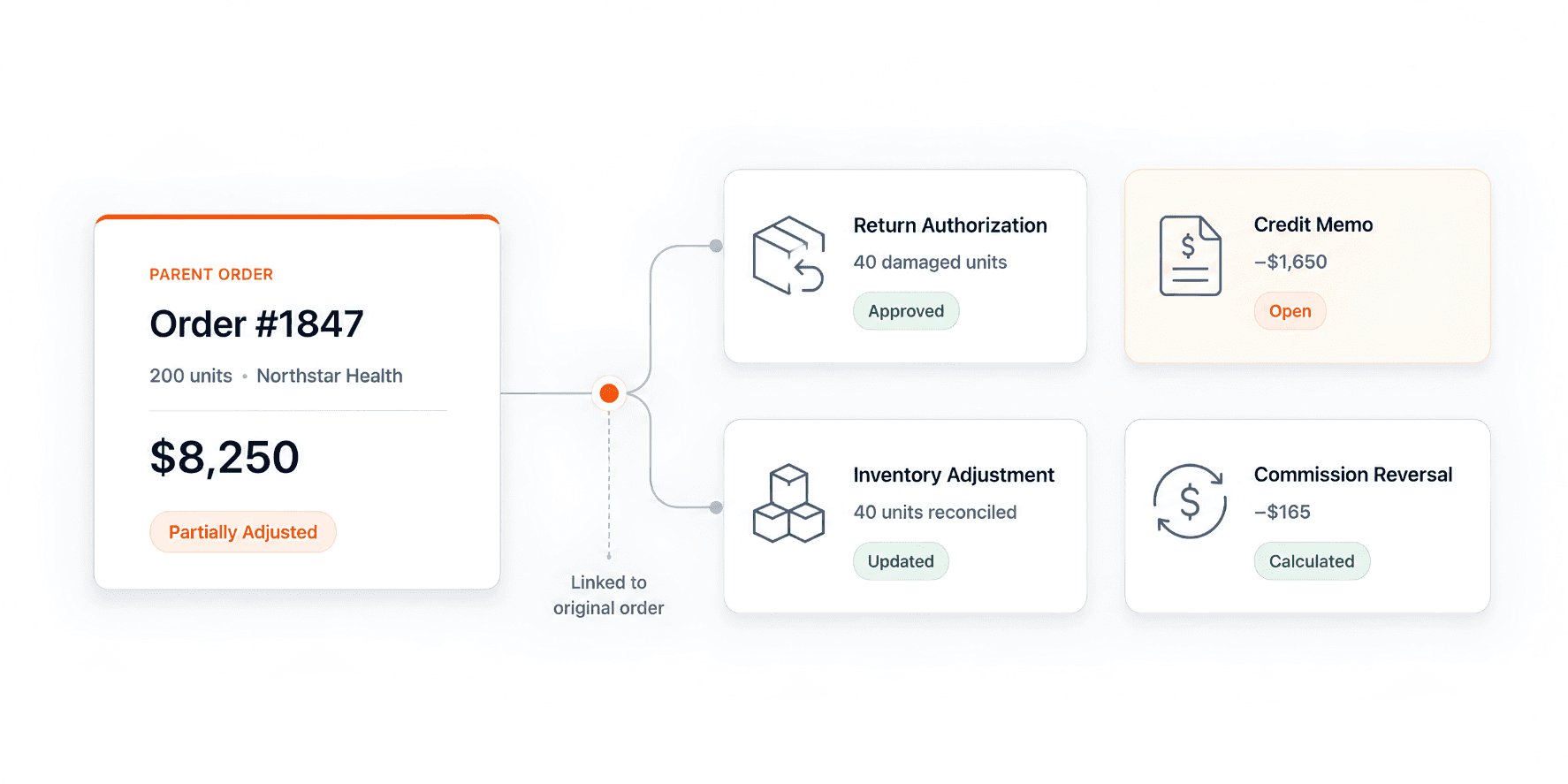
A wholesale return is not a single action. It is a chain of linked adjustments that must remain attached to the original order.
Consider a common scenario. A distributor ships 200 units, 40 arrive damaged, and the customer wants a credit rather than a replacement. Handling that correctly means issuing a return authorization, deciding whether the damaged units should be returned or destroyed in place, adjusting inventory accordingly, issuing a credit memo against the original invoice, applying that credit to the customer's balance instead of issuing a cash refund, and reversing the commission on the 40 units.
Six adjustments. Five systems. And one rep who already told the customer the credit was applied.
Spreadsheets can handle the first adjustment. The failure happens at linkage. A credit tracked in a separate tab has no structural connection to the invoice it reduces. The only things tying them together are a note in a cell and somebody's memory. When that person is on vacation and a customer asks why the statement still shows the full amount, the answer requires reconstruction rather than a simple lookup.
Build these three distinctions into your process before you build them into software:
Credit memo versus refund. A credit memo reduces an outstanding balance and keeps the cash in the business. A refund returns cash. Wholesale typically defaults to credit memos, and treating them as interchangeable with refunds overstates cash outflow.
Return versus short ship. A return means goods came back and inventory increases. A short ship means goods never arrived and inventory was never depleted. Recording one as the other silently corrupts stock counts.
Price adjustment versus goods adjustment. A billing error corrected after invoicing changes revenue without touching inventory or fulfillment. Mixing these into a single "credits" bucket makes it impossible to determine whether the problem is pricing accuracy or warehouse accuracy.
How Post-Order Adjustments Corrupt Your Reporting
Unlinked adjustments rarely announce themselves. They quietly move three numbers in three different directions.
Revenue reporting is usually the first casualty. Gross bookings remain high while net revenue falls. If credits are recorded separately from orders, the gap stays hidden until month-end close. Sales leadership sees one number, finance sees another, and both are internally consistent.
Inventory accuracy is the second casualty. Returned goods that are physically restocked but not recorded in the system distort available inventory and can lead to overselling. Goods recorded as returned but never physically inspected create the opposite problem.
Commissions are the third, and the most visible to the reps affected. Reps may be paid on orders that are later credited. The reversal then either never happens, costing margin, or appears quarters later without explanation, costing trust. Our guide to sales commission management explains why spreadsheet-based compensation breaks down at this point.
Each of these failure traces back to one design decision: whether the adjustment belongs to the original order or exists as a separate record that merely references it.
What to Look For in a Wholesale Order Management System
Wholesale order management software evaluations often focus on order capture features because those features demo well. The capabilities that determine whether the system holds up are harder to see.
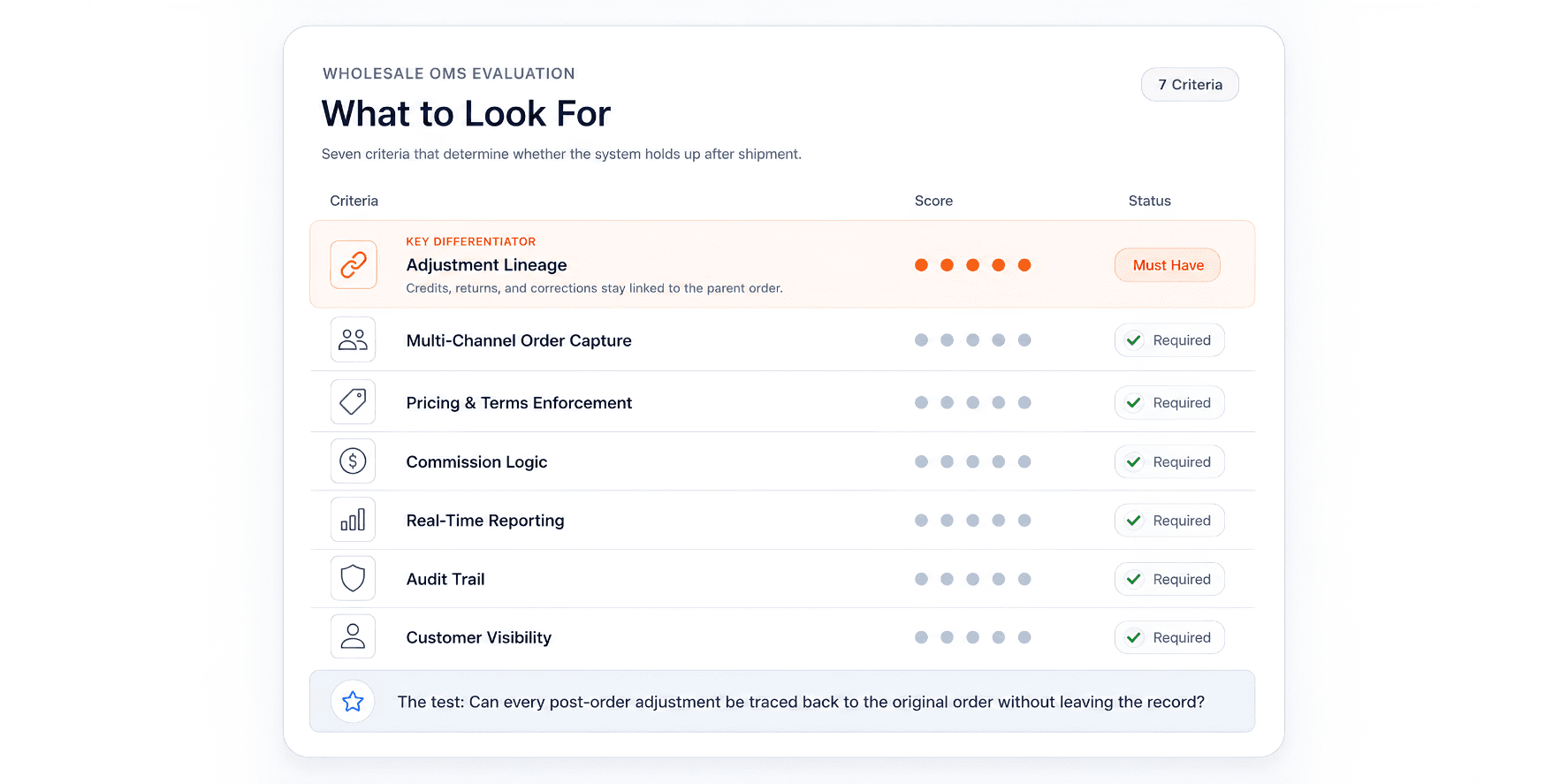
A wholesale order management system proves its value by keeping the entire order-to-cash cycle in one record, including everything that happens after shipment. Use these criteria to evaluate your options:
Adjustment lineage. Every credit, return, and price correction should remain attached to the parent order and be visible from the original record. If you must search another module to determine whether an order was credited, the connection is not truly integrated.
Multi-channel order capture in a shared record. Rep-entered, portal, and customer-service orders should create the same record with the same fields, not three separate formats reconciled later.
Native pricing and terms enforcement. Tier pricing, customer-specific price lists, credit limits, and net terms should be validated at entry, not corrected during invoicing.
Commission logic tied to order status. Commission reversals should follow credits automatically, without monthly reconciliation.
Real time reporting across order, shipment, customer, and commission data. If any one of those requires an export to be joined to the others, your reporting cadence is limited by whoever builds the export.
An audit trail. Every change should record the user, timestamp, and reason.
Customer-facing visibility. Buyers who can see their own order history, credits, and balances raise fewer disputes. That visibility is one of the strongest arguments for a B2B customer portal.
If you are earlier in the evaluation process and still mapping the category, our comparison of the best order management systems covers vendor-level differences in more depth.
Building a Single Source of Truth Across Every Channel
The practical goal is simple: one record per order that holds every event and remains accessible to every team that needs it.
Velocity Commerce is built around that requirement. Orders placed by field reps, through ecommerce, and by customer service enter in the same system, keeping pricing, commissions, inventory, and customer aligned across every channel. Credits and returns remain tied to the original order, commission reversals follow automatically, and reporting draws from one dataset instead of several exports stitched together.
Reps see their customers, orders, and commissions. Finance sees net revenue with adjustments already applied. Customers can view their order history and balances without calling support. Velocity Commerce runs as a native Shopify app, integrates with BigCommerce, and operates as a standalone platform.
Final Thoughts
Wholesale order management should be judged on how it handles messy cases, not clean ones. Any system can record an order that ships in full and is paid on time. The real test comes when 40 units arrive damaged, the rep has already been paid, and the customer wants a credit instead of a refund.
Teams that treat post-order adjustments as a core part of the order lifecycle gain cleaner revenue reporting, more accurate inventory, and fewer commission disputes. Teams that handle them as spreadsheet exceptions face all three problems at once, usually during quarter-end close.
See how Velocity Commerce keeps orders, credits, and commissions connected in a single source of truth. Request a demo.
FAQs
What is the difference between CRM and OMS?
A CRM manages relationships and sales activity: contacts, opportunities, notes, and pipeline. An OMS manages transactions: the order record, pricing, fulfillment status, invoicing, and adjustments. A CRM tells you a customer is likely to buy. An OMS tells you what they bought, at what price, and whether any of it was credited back.
What are the 4 stages of order management?
Capture, validation, fulfillment handoff, and settlement. Capture records the order across whatever channel it arrives on. Validation applies pricing, terms, and credit rules. Fulfillment handoff moves the order to the warehouse and tracks what shipped. Settlement covers invoicing, payment, and any credits or returns applied afterward.
How much does an OMS system cost?
Pricing for wholesale order management software generally runs from a few hundred dollars per month for entry-level tools to five figures annually for platforms that include rep ordering, commission management, and multi-channel capture. The variables that move the price most are order volume, number of rep users, and whether the platform includes native ecommerce integration or requires middleware.
What are the four types of wholesalers?
Merchant wholesalers, who take ownership of the goods they sell. Brokers and agents, who arrange transactions without taking ownership. Manufacturers' sales branches and offices, which sell direct on behalf of the producer. And specialty or limited-service wholesalers, such as cash-and-carry or drop shippers, which handle only part of the distribution function.
How do you handle returns for wholesale orders?
Issue a return authorization tied to the original order, decide whether goods return to inventory or are written off, adjust stock accordingly, issue a credit memo against the original invoice rather than a cash refund, and reverse any commission paid on the returned units. Every one of those steps should reference the parent order so the full history stays reconstructable.